


Last Updated: June 17th, 2026 by Jeffrey Christo
In the world of sports, curses are as much a part of the mythology as the legendary players themselves. From the Curse of the Bambino that haunted the Boston Red Sox to the Billy Goat Curse that plagued the Chicago Cubs, these tales of misfortune offer fans a narrative to latch onto during times of hardship. Yet, perhaps the most bizarre sports curse belongs not to an American team, but to the Hanshin Tigers of Japan, who for decades were said to be haunted by none other than Colonel Sanders.
Don't lose this article. Enter your email below, and I'll send it to you right now. Plus, we'll send you other unbelievable stories from baseball's past.
Yes, you read that right. The same smiling face that greets you at your local KFC became a specter of doom for the Hanshin Tigers, one of Japan’s most beloved baseball teams. The origins of this peculiar curse trace back to 1985, a year that saw the Tigers defy all odds to win their first Central League pennant. The celebrations were pandemonium, with fans frolicking through the streets of Osaka, culminating in a raucous gathering at the Dōtonbori Canal.
In the euphoria, fans jumped into the canal, each representing a player from the team. But when it came time to honor Randy Bass, the American slugger and team hero, the fans faced a dilemma—there was no one quite like him. But there was something nearby that bore a resemblance: a statue of Colonel Sanders, perched outside a local KFC. In their inebriated jubilation, fans seized the Colonel and hurled him into the murky waters, unwittingly setting the stage for a legend that would haunt the team for decades.
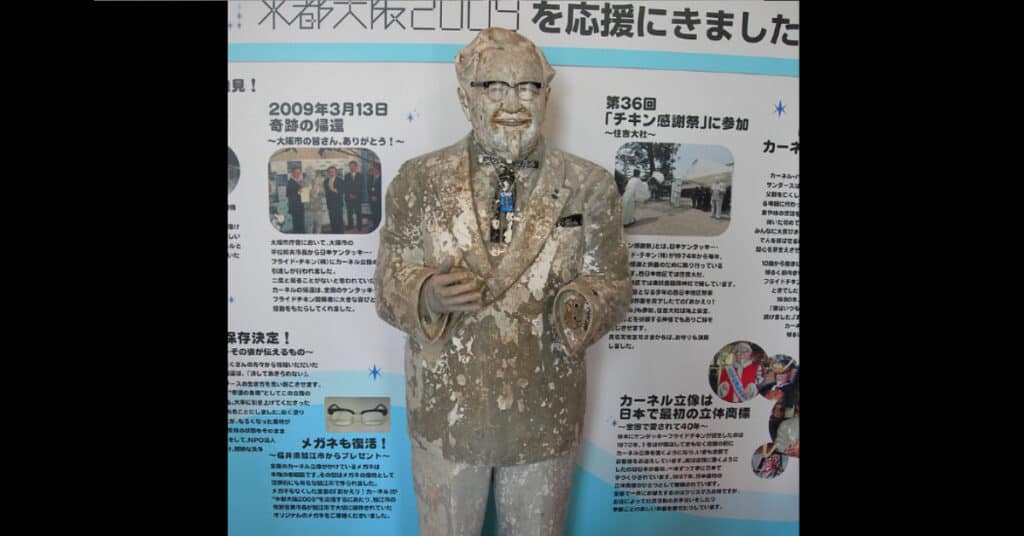
What followed was a string of misfortunes for the Tigers, fueling the belief that the Colonel’s curse was real. Star players were plagued with injuries, management floundered, and the team languished at the bottom of the league standings year after year. Despite numerous attempts to retrieve the statue, including diving expeditions and dredging efforts, the Colonel remained elusive, firmly entrenched in the canal’s depths.
The parallel to the Curse of the Bambino was not lost on fans or the media. Just as Babe Ruth’s departure from Boston became a symbol of the Red Sox’s struggles, the Colonel’s watery grave became a touchstone for the Tigers. Yet, unlike the Red Sox, whose curse was rooted in a tangible transaction, the Tigers’ curse was born of pure whimsy and chaos—a testament to the unpredictability of sports and the narratives we create.
In 2009, a routine cleaning of the canal finally brought the Colonel back to the surface. Though missing his glasses and a hand, his reemergence was heralded by fans as a sign of hope. For the Tigers, however, the curse seemed to linger. Seasons came and went with fleeting success, but no championships.
Fast forward to 2023, a year that saw the Tigers once again defy expectations, clinching the Central League title and advancing to the Japan Series. Fans, wary of tempting fate, gathered at the canal post-victory, but the celebrations were subdued compared to those of the past. Perhaps the specter of the Colonel still loomed large, or perhaps the fans had grown wiser, realizing that curses, like all superstitions, hold power only if we allow them to.
The curse was finally broken, not with a grand gesture, but with quiet determination and resilience. The Colonel, whose statue now resides safely at a KFC office, became a relic of the past—a humorous footnote in the Tigers’ storied history.
What does this mean for the world of sports and the culture of curses? In Japan, where baseball fandom is as fervent as anywhere else, the Colonel’s curse stands as a reminder of the stories we tell ourselves in the face of adversity. It underscores the power of belief and the role of narrative in shaping the identity of a team and its followers.
For the Hanshin Tigers, the lifting of the Colonel’s curse marks a new chapter, one where the past informs but does not define their future. As fans celebrated their long-awaited victory, they did so with a sense of history and humor, aware that the legend of the Colonel is as much a part of their culture as the game itself.

In the end, the real magic of the Colonel’s curse lies not in its supposed power to influence outcomes, but in its ability to unite a community. It is a story that transcends borders, resonating with anyone who has ever rooted for an underdog. As the Tigers look ahead, the curse of the Colonel will remain a cherished part of their legacy—a tale of triumph over the most unlikely of adversaries.