
Last Updated: June 17th, 2026 by Michael Schatz
No franchise in baseball has produced a pitching tradition quite like the Dodgers. From Ebbets Field to Chavez Ravine, the men who took the mound in this uniform have authored some of the most unhittable seasons the sport has ever seen — perfect games, no-hitters, sub-2.00 ERAs, scoreless-inning streaks for the ages. This list counts down the 20 greatest Dodgers pitchers of all time, ranked by what they actually did while wearing the uniform.
Don't lose this article. Enter your email below, and I'll send it to you right now. Plus, we'll send you other unbelievable stories from baseball's past.
A few ground rules. Brooklyn and Los Angeles both count — they are one continuous franchise, and the careers of Dazzy Vance, Burleigh Grimes, and Whit Wyatt deserve to sit beside Kershaw, Koufax, and Drysdale on the same shelf. Career numbers from other teams are ignored. A pitcher’s case rests on three things: their best individual seasons, the length of time they were dominant in this uniform, and what they did in October.
We’re counting down from #20 to #1, so scroll all the way through. The top of this list is one of the toughest #1 vs. #2 debates in baseball history, and a few names you might not expect made the cut. Let’s get into it.
How We Made This List
We ranked only what each pitcher accomplished for the Dodgers franchise in Brooklyn and Los Angeles, weighing peak performance, sustained dominance, postseason impact, and longevity. Career numbers from other clubs do not affect the order. The source already counts down from No. 20 to No. 1, and that original editorial ranking is preserved.
20. Kevin Brown
1999-2003
| Kevin Brown — Career | Total |
|---|---|
| W | 211 |
| L | 144 |
| ERA | 3.28 |
| G | 486 |
| IP | 3256.1 |
| SO | 2397 |
| WHIP | 1.22 |
| SV | 0 |
| All-Star selections | 6 |
| World Series titles | 1 |
With the team: 58-32 record, 0 saves, 784 strikeouts, 2.83 ERA, 2× All-Star
Kevin Brown anchored the Dodgers rotation from 1999 through 2003, arriving as one of baseball’s most dominant pitchers. Over five seasons in Los Angeles, he posted a 2.83 ERA across 872.2 innings with 784 strikeouts, winning 58 games against 32 losses. He earned two All-Star selections during his Dodgers tenure.
His first season in Dodger blue set the tone immediately. Brown won 18 games in 1999 with a 3.00 ERA, establishing himself as the staff ace.
The 2000 campaign proved even more dominant statistically. Brown led the National League in both ERA at 2.58 and WHIP at 0.99, showcasing the command and power sinker that made him so difficult to square up.
His 11 complete games over five seasons reflected an era when starters still routinely finished what they started. Brown’s sub-3.00 ERA across nearly 900 innings represents one of the most sustained stretches of excellence by any Dodgers pitcher during the franchise’s modern era in Los Angeles.
19. Claude Osteen
1965-1973
| Claude Osteen — Career | Total |
|---|---|
| W | 196 |
| L | 195 |
| ERA | 3.30 |
| G | 541 |
| IP | 3460.1 |
| SO | 1612 |
| WHIP | 1.27 |
| SV | 1 |
| All-Star selections | 3 |
| World Series titles | 1 |
With the team: 147-126 record, 0 saves, 1162 strikeouts, 3.09 ERA, 3× All-Star
Claude Osteen anchored the Dodgers rotation from 1965 through 1973, compiling 147 wins across nine seasons in Los Angeles. The left-hander logged 2,396.2 innings with a 3.09 ERA while completing 100 games and recording 34 shutouts. His durability showed in 335 starts across 339 appearances, making him one of the franchise’s most reliable workhorses of the era.
Osteen earned three All-Star selections as a Dodger and contributed to the 1965 World Series championship team. His finest season came in 1969 when he posted 20 wins, the only 20-win campaign of his Los Angeles tenure.
He also won 17 games in 1967 while earning All-Star honors, then returned to the Midsummer Classic again in 1970. Osteen’s consistency kept the Dodgers competitive throughout the late 1960s and early 1970s, providing steady production year after year.
His 147 victories rank among the highest win totals by any pitcher in Dodgers history during the Los Angeles era.
18. Hideo Nomo
1995-1998, 2002-2004
| Hideo Nomo — Career | Total |
|---|---|
| W | 123 |
| L | 109 |
| ERA | 4.24 |
| G | 323 |
| IP | 1976.1 |
| SO | 1918 |
| WHIP | 1.35 |
| SV | 0 |
| All-Star selections | 1 |
| Rookie of the Year | 1 |
With the team: 81-66 record, 0 saves, 1200 strikeouts, 3.74 ERA, 1× All-Star
Hideo Nomo pitched for the Dodgers across seven seasons in two stints, from 1995 through 1998 and from 2002 through 2004, arriving as a groundbreaking figure from Japan. He posted an 81-66 record with a 3.74 ERA over 191 starts, striking out 1,200 batters in 1,217.1 innings while completing 12 games and recording seven shutouts.
His 1995 debut season made him the first Japanese-born player in Dodgers history to appear in an MLB game, and he captured National League Rookie of the Year honors. That rookie campaign included a 16-strikeout performance that helped establish him as a sensation.
Nomo threw a no-hitter against the Colorado Rockies at Coors Field on September 17, 1996, the first no-hitter in that ballpark’s history. He earned one All-Star selection during his Dodgers tenure.
His 1,200 strikeouts in a Dodgers uniform represent the impact of a pitcher who opened the door for Japanese players in Los Angeles and delivered consistent production across two separate stints with the franchise.
17. Bob Welch
1978-1987
| Bob Welch — Career | Total |
|---|---|
| W | 211 |
| L | 146 |
| ERA | 3.47 |
| G | 506 |
| IP | 3092.0 |
| SO | 1969 |
| WHIP | 1.27 |
| SV | 8 |
| Cy Young | 1 |
| All-Star selections | 2 |
| World Series titles | 2 |
With the team: 115-86 record, 8 saves, 1292 strikeouts, 3.14 ERA, 1× All-Star
Bob Welch pitched for the Dodgers from 1978 through 1987, compiling 115 wins against 86 losses over 10 seasons. He posted a 3.14 ERA across 1,820.2 innings while striking out 1,292 batters and completing 47 games with 23 shutouts.
His arrival announced itself dramatically in 1978 when, as a 21-year-old rookie, he struck out Reggie Jackson to end Game 2 of the World Series and preserve a 4-3 Dodgers victory over the Yankees. That confrontation between the young fireballer and the veteran slugger became one of the defining images of that Fall Classic.
Welch recorded a save in the 1981 National League Championship Series as Los Angeles captured the pennant. The Dodgers went on to win the World Series that strike-shortened season.
He earned one All-Star selection during his Dodgers tenure and closed his Los Angeles career in 1987 with a 15-9 record. His 115 wins reflect a decade of durability and consistent performance on the mound.
16. Whit Wyatt
1939-1944
| Whit Wyatt — Career | Total |
|---|---|
| W | 106 |
| L | 95 |
| ERA | 3.79 |
| G | 360 |
| IP | 1761.0 |
| SO | 872 |
| WHIP | 1.32 |
| SV | 13 |
| All-Star selections | 4 |
With the team: 80-45 record, 1 saves, 540 strikeouts, 2.86 ERA, 4× All-Star
Whit Wyatt pitched for the Dodgers from 1939 through 1944, anchoring Brooklyn’s rotation during the franchise’s resurgence in the early 1940s. Over six seasons, he compiled an 80-45 record with a 2.86 ERA across 157 appearances, completing 75 of his 148 starts.
His 1941 campaign stands as one of the finest pitching seasons in franchise history. Wyatt led the National League with 22 wins and seven shutouts, helping Brooklyn capture the NL pennant. He earned four major league All-Star selections during his Dodgers tenure.
Wyatt won 19 games in 1942, then went 14-5 with a 2.49 ERA in 1943. His 17 shutouts as a Dodger reflected his ability to dominate lineups in an era when complete games defined pitching excellence.
No pitcher won more games for Brooklyn during the early 1940s than Wyatt, whose 80 victories in six seasons established him as the staff ace who delivered the franchise’s first pennant in over two decades.
15. Preacher Roe
1948-1954
| Preacher Roe — Career | Total |
|---|---|
| W | 127 |
| L | 84 |
| ERA | 3.45 |
| G | 333 |
| IP | 1914.1 |
| SO | 956 |
| WHIP | 1.26 |
| SV | 10 |
| All-Star selections | 4 |
With the team: 93-37 record, 4 saves, 632 strikeouts, 3.26 ERA, 4× All-Star
Preacher Roe pitched for the Dodgers from 1948 through 1954, compiling a 93-37 record across seven seasons. His 3.26 ERA and 74 complete games anchored Brooklyn’s rotation during one of the franchise’s most competitive eras.
The left-hander’s 1951 campaign stands as one of the finest single seasons by any Dodgers pitcher. He went 22-3 with a 3.04 ERA, started the season 10-0, and led the National League with an .880 winning percentage. The performance earned him The Sporting News Pitcher of the Year honors.
Between 1951 and 1953, Roe went 44-8 overall, helping the Dodgers capture the 1952 and 1953 pennants. He earned four All-Star selections with Brooklyn and recorded 12 shutouts in 173 starts.
His 93 wins against just 37 losses represent one of the most dominant winning percentages in franchise history for pitchers with significant tenure.
14. Carl Erskine
1948-1959
| Carl Erskine — Career | Total |
|---|---|
| W | 122 |
| L | 78 |
| ERA | 4.00 |
| G | 335 |
| IP | 1718.2 |
| SO | 981 |
| WHIP | 1.33 |
| SV | 13 |
| All-Star selections | 1 |
| World Series titles | 1 |
With the team: 122-78 record, 13 saves, 981 strikeouts, 4.00 ERA, 1× All-Star
Carl Erskine pitched for the Dodgers from 1948 through 1959, compiling 122 wins against 78 losses across 335 appearances. He started 216 games and completed 71 of them, recording 14 shutouts and 981 strikeouts over 1,718.2 innings with a 4.00 ERA.
His signature moment came on October 2, 1953, when he set a World Series record by striking out 14 New York Yankees in Game 3. He won that game for Brooklyn, delivering one of the most dominant postseason pitching performances in franchise history.
Erskine pitched a no-hitter against the Chicago Cubs on June 19, 1952, cementing his reputation as one of Brooklyn’s most reliable starters. He earned one All-Star selection during his tenure, helped Brooklyn win the 1955 World Series, and appeared in 10 games for the 1959 pennant-winning club before his final major league game that June.
Over 12 seasons in Dodger blue, Erskine provided the consistency and October excellence that defined the Boys of Summer era, his World Series strikeout record standing as testament to his ability to elevate his performance when it mattered most.
13. Eric Gagne
1999-2006
| Eric Gagne — Career | Total |
|---|---|
| W | 33 |
| L | 26 |
| ERA | 3.47 |
| G | 402 |
| IP | 643.2 |
| SO | 718 |
| WHIP | 1.16 |
| SV | 187 |
| Cy Young | 1 |
| All-Star selections | 3 |
| World Series titles | 1 |
With the team: 25-21 record, 161 saves, 629 strikeouts, 3.27 ERA, 3× All-Star
Eric Gagne pitched for the Dodgers from 1999 to 2006, transforming from a struggling starter into one of baseball’s most dominant closers. Over eight seasons, he recorded 161 saves and struck out 629 batters in 545.1 innings while posting a 3.27 ERA across 298 appearances.
His 2003 campaign stands as one of the greatest relief seasons in franchise history. Gagne won the National League Cy Young Award and converted all 55 of his save opportunities.
The streak extended beyond that year. From 2002 through 2004, Gagne converted 84 consecutive save opportunities, setting an MLB record for the most consecutive saves at the time.
He earned three All-Star selections with the Dodgers and won back-to-back Rolaids Relief Man Awards in 2003 and 2004. His 2003 season also brought him recognition as The Sporting News Pitcher of the Year and Reliever of the Year.
No closer in Dodgers history has matched Gagne’s combination of sustained excellence and record-breaking dominance during his peak years.
12. Nap Rucker
1907-1916
| Nap Rucker — Career | Total |
|---|---|
| W | 134 |
| L | 134 |
| ERA | 2.42 |
| G | 336 |
| IP | 2375.1 |
| SO | 1217 |
| WHIP | 1.17 |
| SV | 14 |
With the team: 134-134 record, 14 saves, 1217 strikeouts, 2.42 ERA
Nap Rucker anchored the Brooklyn pitching staff from 1907 through 1916, compiling 134 wins against 134 losses across 336 appearances. The left-hander threw 2,375.1 innings for the franchise, recording 1,217 strikeouts and posting a 2.42 ERA during the dead-ball era.
His 1908 campaign established him as an elite National League pitcher, as he went 17-19 with a 2.08 ERA and six shutouts. That September, Rucker threw the first no-hitter by a left-handed pitcher in Dodgers history.
He followed with another strong season in 1910, going 17-18 with a 2.58 ERA and six shutouts.
His 38 shutouts and 186 complete games reflected the workhorse expectations of his era. Despite pitching for mostly mediocre Brooklyn clubs, Rucker maintained consistent excellence throughout his decade with the franchise.
No pitcher in Brooklyn history logged more innings or complete games for the club during the dead-ball period than Rucker.
11. Johnny Podres
1953-1966
| Johnny Podres — Career | Total |
|---|---|
| W | 148 |
| L | 116 |
| ERA | 3.68 |
| G | 440 |
| IP | 2265.0 |
| SO | 1435 |
| WHIP | 1.32 |
| SV | 11 |
| All-Star selections | 3 |
| World Series titles | 3 |
With the team: 136-104 record, 6 saves, 1331 strikeouts, 3.66 ERA, 3 All-Star selection seasons
Johnny Podres pitched for the Dodgers from 1953 through 1966, compiling 136 wins against 104 losses across 366 appearances. Over 2,029.1 innings, he struck out 1,331 batters while posting a 3.66 ERA and recording 23 shutouts. He appeared in four All-Star Games across three selection seasons during his tenure with the club.
His defining moment came in 1955 when he threw a complete-game victory in Game 7 of the World Series against the Yankees, delivering the franchise its first championship. That performance earned him both the World Series MVP and Babe Ruth Award.
Podres contributed to three World Series titles with the Dodgers in 1955, 1959, and 1963. In 1959, he went 14-9 as the club won another championship.
No Dodgers pitcher is more synonymous with the franchise’s first World Series triumph than the left-hander who shut down the Yankees when it mattered most.
10. Burleigh Grimes (HOF)
1918-1926
| Burleigh Grimes — Career | Total |
|---|---|
| W | 270 |
| L | 212 |
| ERA | 3.53 |
| G | 616 |
| IP | 4179.2 |
| SO | 1512 |
| WHIP | 1.37 |
| SV | 18 |
| World Series titles | 1 |
With the team: 158-121 record, 5 saves, 952 strikeouts, 3.47 ERA
Burleigh Grimes pitched nine seasons for Brooklyn from 1918 through 1926, anchoring the rotation as the franchise’s most durable starter of the era. The spitball specialist won 158 games against 121 losses with a 3.47 ERA across 318 appearances, completing 205 of his 287 starts and recording 20 shutouts.
His 1920 campaign stands as one of the finest pitching seasons in franchise history. Grimes went 23-11 with a 2.22 ERA and completed 25 games as Brooklyn won the National League pennant.
His first Brooklyn season in 1918 set the tone with a 19-9 record and 2.14 ERA in 33 games.
Grimes accumulated 2,425.2 innings and 952 strikeouts in Brooklyn before moving on in 1927, eventually earning Hall of Fame induction in 1964. His 158 victories remain among the highest win totals in franchise history for a single pitcher.
9. Kenley Jansen
2010-2021
| Kenley Jansen — Career | Total |
|---|---|
| W | 57 |
| L | 44 |
| ERA | 2.61 |
| G | 967 |
| IP | 958.0 |
| SO | 1315 |
| WHIP | 0.97 |
| SV | 489 |
| All-Star selections | 4 |
| World Series titles | 1 |
With the team: 37-26 record, 350 saves, 1022 strikeouts, 2.37 ERA, 3× All-Star
Kenley Jansen anchored the Dodgers bullpen from 2010 through 2021, converting from catcher to closer and redefining dominance at the back end. Over 12 seasons in Los Angeles, he recorded 350 saves across 701 appearances, striking out 1,022 batters while posting a 2.37 ERA.
His peak arrived in 2016 when he earned NL Reliever of the Year honors and became the Dodgers’ all-time saves leader on June 20. He repeated as Reliever of the Year in 2017, cementing consecutive seasons of elite performance.
Jansen earned three All-Star selections with the Dodgers and played a crucial role in their 2020 World Series championship. His cutter became one of baseball’s most unhittable pitches, generating swings and misses that left hitters shaking their heads.
When he departed after 2021, Jansen held the franchise record for saves by a margin that reflected his sustained excellence. No reliever in Dodgers history appeared in more games or recorded more strikeouts than the Curaçao native who transformed himself into the most prolific closer in franchise history.
8. Don Newcombe
1949-1951, 1954-1958
| Don Newcombe — Career | Total |
|---|---|
| W | 156 |
| L | 96 |
| ERA | 3.58 |
| G | 362 |
| IP | 2274.0 |
| SO | 1210 |
| WHIP | 1.21 |
| SV | 7 |
| MVP | 1 |
| Cy Young | 1 |
| All-Star selections | 4 |
| World Series titles | 1 |
| Rookie of the Year | 1 |
With the team: 123-66 record, 4 saves, 913 strikeouts, 3.51 ERA, 4× All-Star
Don Newcombe pitched for the Dodgers from 1949 through 1958, establishing himself as one of the franchise’s most dominant right-handers of the era. Over eight seasons, he compiled 123 wins against 66 losses with a 3.51 ERA across 258 appearances, completing 111 of his 230 starts.
His 1949 debut season produced a Rookie of the Year Award after he went 17-8 and led the National League in shutouts. Newcombe earned four All-Star selections during his Dodgers tenure and contributed to the franchise’s 1955 World Series championship.
The 1956 campaign stands as his signature achievement. He went 27-7 that season, capturing both the National League Most Valuable Player Award and the Cy Young Award. A year earlier, he had also hit seven home runs.
Newcombe remains the only Dodger to win the Rookie of the Year, MVP, and Cy Young Award during his time with the franchise.
7. Fernando Valenzuela
1980-1990
| Fernando Valenzuela — Career | Total |
|---|---|
| W | 173 |
| L | 153 |
| ERA | 3.54 |
| G | 453 |
| IP | 2930.0 |
| SO | 2074 |
| WHIP | 1.32 |
| SV | 2 |
| Cy Young | 1 |
| All-Star selections | 6 |
| Gold Gloves | 1 |
| Silver Sluggers | 2 |
| World Series titles | 1 |
| Rookie of the Year | 1 |
With the team: 141-116 record, 2 saves, 1759 strikeouts, 3.31 ERA, 6× All-Star
Fernando Valenzuela pitched for the Dodgers from 1980 to 1990, compiling 141 wins and a 3.31 ERA across 331 appearances. The left-hander struck out 1,759 batters over 2,348.2 innings and completed 107 games with 29 shutouts during his 11 seasons in Los Angeles.
His 1981 rookie campaign remains unmatched in franchise lore. Valenzuela became the first player ever to win both the Rookie of the Year Award and the Cy Young Award in the same season, sparking a cultural phenomenon that transcended baseball.
He delivered a complete-game victory in Game 3 of the 1981 World Series, helping secure the championship. The six-time All-Star remained with the club during its 1988 championship season and threw a no-hitter against the Cardinals on June 29, 1990, in a 6-0 victory.
Valenzuela’s 141 wins and 29 shutouts place him among the most accomplished pitchers to wear Dodger blue in Los Angeles.
6. Dazzy Vance (HOF)
1922-1932, 1935
| Dazzy Vance — Career | Total |
|---|---|
| W | 197 |
| L | 140 |
| ERA | 3.24 |
| G | 442 |
| IP | 2966.2 |
| SO | 2045 |
| WHIP | 1.23 |
| SV | 11 |
| World Series titles | 1 |
With the team: 190-131 record, 7 saves, 1918 strikeouts, 3.17 ERA
Dazzy Vance pitched for Brooklyn from 1922 through 1932 and returned in 1935, establishing himself as the dominant strikeout artist of the 1920s. Over 12 seasons, he won 190 games with a 3.17 ERA and struck out 1,918 batters across 2,757.2 innings.
His 1924 campaign stands as one of the finest pitching seasons in franchise history. Vance won the National League MVP and the pitching Triple Crown, leading the league with 28 wins, 262 strikeouts, and the lowest ERA.
Beginning in 1922, Vance led the National League in strikeouts for seven consecutive seasons through 1928, a record-setting streak for a Dodgers pitcher. He completed 212 games and recorded 29 shutouts during his Brooklyn tenure.
The Baseball Writers elected Vance to the Hall of Fame in 1955. He remains the franchise’s all-time leader in strikeouts among pitchers who spent their prime years in Brooklyn.
5. Orel Hershiser
1983-1994, 2000
| Orel Hershiser — Career | Total |
|---|---|
| W | 204 |
| L | 150 |
| ERA | 3.48 |
| G | 510 |
| IP | 3130.1 |
| SO | 2014 |
| WHIP | 1.26 |
| SV | 5 |
| Cy Young | 1 |
| All-Star selections | 3 |
| Gold Gloves | 1 |
| Silver Sluggers | 1 |
| World Series titles | 1 |
With the team: 135-107 record, 5 saves, 1456 strikeouts, 3.12 ERA, 3× All-Star
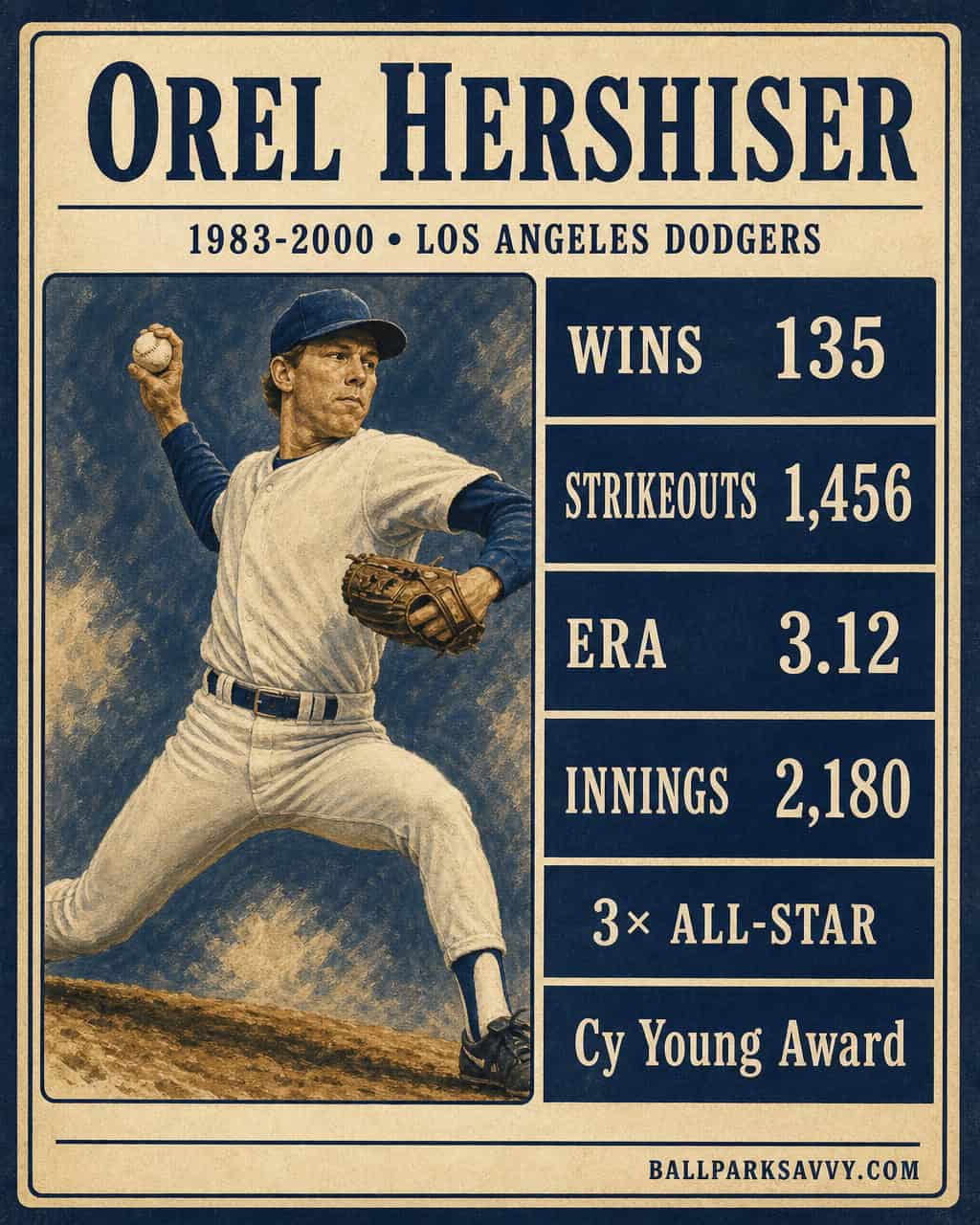
Orel Hershiser pitched for the Dodgers from 1983 through 1994 and returned in 2000, compiling 135 wins against 107 losses over 13 seasons. He recorded a 3.12 ERA across 2,180.2 innings with 1,456 strikeouts, throwing 65 complete games and 24 shutouts during his tenure.
The 1988 season defined Hershiser’s career and franchise legacy. He set a major league record with 59 consecutive scoreless innings during the regular season, then won the Cy Young Award after posting a 23-8 record with a 2.26 ERA.
That postseason dominance continued as Hershiser earned both NLCS MVP and World Series MVP honors, leading the Dodgers to the 1988 championship. He also collected a Gold Glove that year, showcasing his all-around excellence on the mound.
Hershiser made three All-Star teams with Los Angeles and even won a Silver Slugger in 1993. His 135 wins and 24 shutouts rank among the highest totals in Dodgers history for the Los Angeles era.
4. Don Sutton (HOF)
1966-1988
| Don Sutton — Career | Total |
|---|---|
| W | 324 |
| L | 256 |
| ERA | 3.26 |
| G | 774 |
| IP | 5282.1 |
| SO | 3574 |
| WHIP | 1.14 |
| SV | 5 |
| All-Star selections | 4 |
With the team: 233-181 record, 5 saves, 2696 strikeouts, 3.09 ERA, 4× All-Star
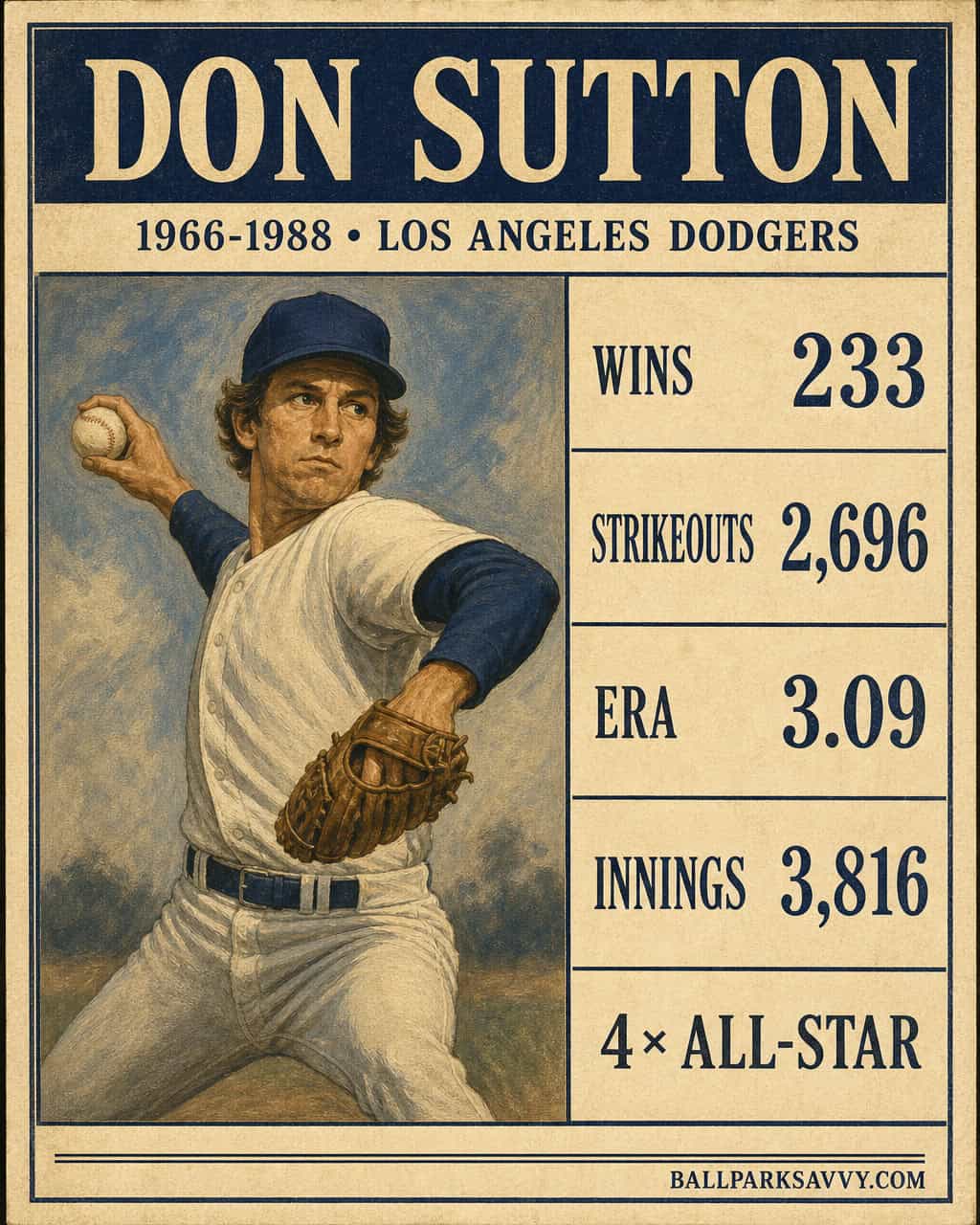
Don Sutton anchored the Dodgers rotation from 1966 through 1980 and returned for a final stint in 1988, compiling 233 wins across 16 seasons in Los Angeles. He logged 3,816.1 innings with 2,696 strikeouts and a 3.09 ERA, throwing 52 shutouts and 156 complete games. The right-hander earned four All-Star selections with the club and took home All-Star Game MVP honors in 1977.
His 1972 campaign stands as a career peak, when he won 19 games with a 2.08 ERA. Sutton set a career high with 21 wins in 1976 and finished that season with a 3.06 ERA.
Sutton left Los Angeles after the 1980 season, then returned to the franchise for 16 starts in 1988 before the Dodgers released him in August.
The Hall of Fame inducted him in 1998. Sutton remains the Dodgers’ franchise wins leader, while Clayton Kershaw has since passed his club strikeout total.
3. Don Drysdale (HOF)
1956-1969
| Don Drysdale — Career | Total |
|---|---|
| W | 209 |
| L | 166 |
| ERA | 2.95 |
| G | 518 |
| IP | 3432.0 |
| SO | 2486 |
| WHIP | 1.15 |
| SV | 6 |
| Cy Young | 1 |
| All-Star selections | 8 |
| World Series titles | 3 |
With the team: 209-166 record, 6 saves, 2486 strikeouts, 2.95 ERA, 9 All-Star Games across 8 selection seasons
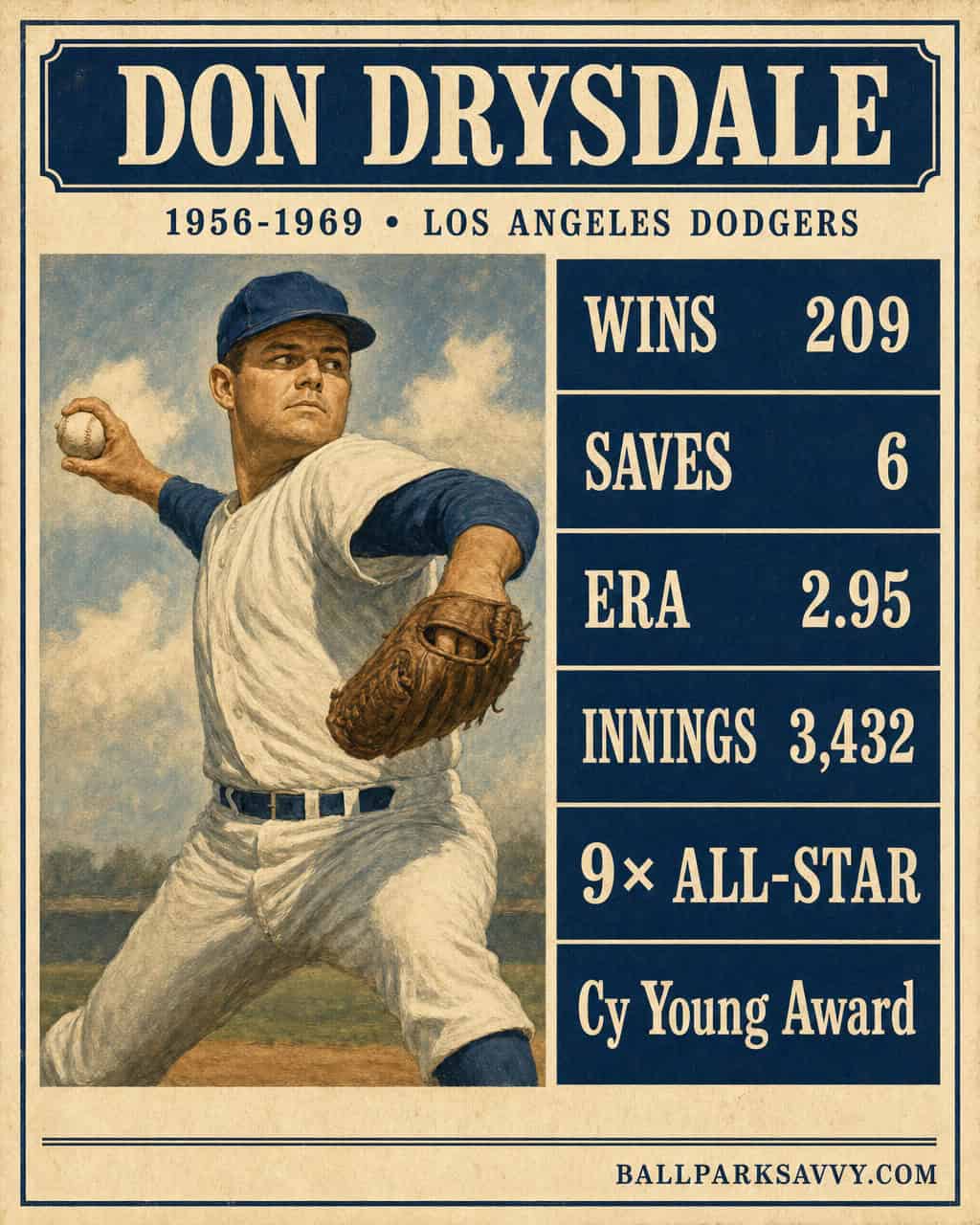
Don Drysdale anchored the Dodgers’ rotation from 1956 through 1969, compiling 209 wins across 14 seasons in Brooklyn and Los Angeles. The right-hander logged 3,432 innings with 2,486 strikeouts and a 2.95 ERA, establishing himself as one of the most durable starters of his era. He threw 49 shutouts and completed 167 games during his tenure.
Drysdale’s 1962 campaign stands as his statistical peak, when he went 25-9 and captured the National League Cy Young Award. That season earned him recognition as The Sporting News Major League Player of the Year, and he appeared in nine All-Star Games across eight selection seasons during his career with the club.
His 1968 season produced one of baseball’s most enduring records: six consecutive shutouts and a scoreless-innings streak that reached 58⅔ frames. Drysdale also delivered in October, starting and winning Game 4 of the 1965 World Series as the Dodgers defeated the Minnesota Twins for the championship.
The franchise won three World Series titles during his time on the mound—1959, 1963, and 1965—with Drysdale serving as a cornerstone of each championship rotation.
2. Sandy Koufax (HOF)
1955-1966
| Sandy Koufax — Career | Total |
|---|---|
| W | 165 |
| L | 87 |
| ERA | 2.76 |
| G | 397 |
| IP | 2324.1 |
| SO | 2396 |
| WHIP | 1.11 |
| SV | 9 |
| MVP | 1 |
| Cy Young | 3 |
| All-Star selections | 6 |
| World Series titles | 3 |
With the team: 165-87 record, 9 saves, 2396 strikeouts, 2.76 ERA, 7 All-Star Games across 6 selection seasons

Sandy Koufax pitched for the Dodgers from 1955 through 1966, compiling a 165-87 record across 12 seasons. Over 2,324.1 innings, he struck out 2,396 batters while posting a 2.76 ERA and recording 40 shutouts.
His 1963 season stands as a statistical masterpiece: a 25-5 record with a 1.88 ERA earned him the National League Cy Young Award and Most Valuable Player honors. He won three Cy Young Awards total with the Dodgers, claiming the honor again in 1965 and 1966.
Koufax threw a perfect game against the Chicago Cubs at Dodger Stadium on September 9, 1965. That same year, he captured World Series MVP after shutting out the Minnesota Twins in Game 7 on two days’ rest.
He appeared in seven All-Star Games across six selection seasons. Koufax was a member of four Dodgers championship clubs and pitched in the 1959, 1963, and 1965 World Series runs before entering the Hall of Fame in 1972.
1. Clayton Kershaw
2008-2025
| Clayton Kershaw — Career | Total |
|---|---|
| W | 223 |
| L | 96 |
| ERA | 2.53 |
| G | 455 |
| IP | 2855.1 |
| SO | 3052 |
| WHIP | 1.02 |
| SV | 0 |
With the team: 223-96 record, 0 saves, 3052 strikeouts, 2.53 ERA, 11× All-Star
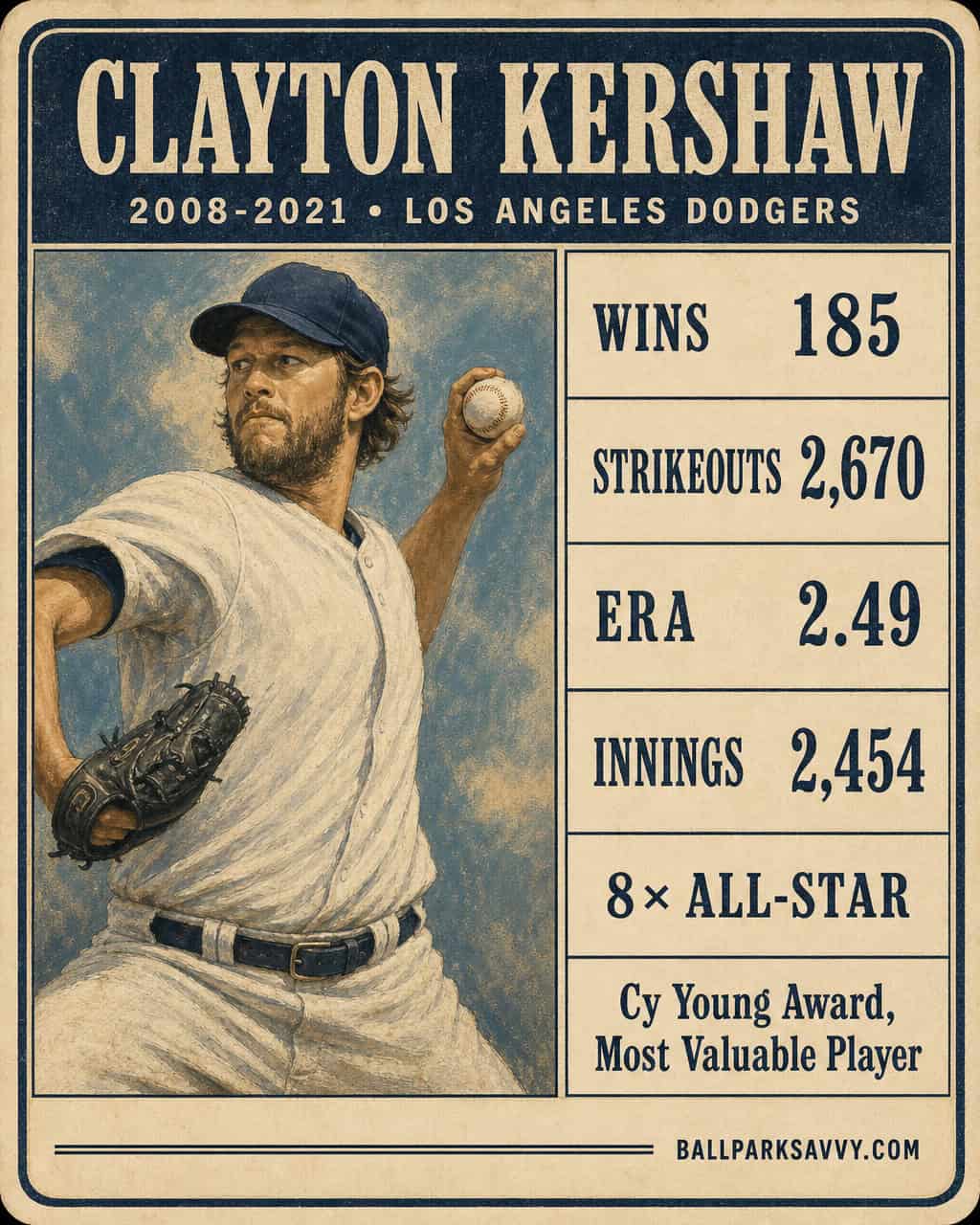
Clayton Kershaw spent his entire 18-season career with the Dodgers from 2008 through 2025. The left-hander compiled 223 wins against 96 losses with a 2.53 ERA, striking out 3,052 batters in 2,855.1 innings pitched.
His trophy case includes three Cy Young Awards in 2011, 2013, and 2014, plus the 2014 NL MVP Award. He earned 11 All-Star selections and captured the pitching Triple Crown in 2011.
The 2014 season stands as his statistical peak, when he went 21-3 with a 1.77 ERA to claim both the Cy Young and MVP honors. That same year, he threw a no-hitter against the Colorado Rockies on June 18.
Kershaw helped deliver the 2020 World Series championship and finished his career as a three-time champion after the Dodgers also won in 2024 and 2025. He retired after the 2025 title run as the franchise’s strikeout leader with 3,052.
The Final Word
Picking between Clayton Kershaw and Sandy Koufax for the top spot is the kind of argument that has no clean answer. Koufax’s four-year peak from 1963 to 1966 is arguably the most dominant stretch any pitcher has ever produced — three Cy Young Awards, an MVP, three of his four career no-hitters including a perfect game, and ERAs that look like typos. Kershaw sustained excellence across an 18-season Dodgers career, winning three Cy Young Awards, an MVP, and three World Series titles before retiring after the 2025 championship run. Don Drysdale rounds out a top three that may be the strongest 1-2-3 of any franchise in baseball.
And those are only the headliners. Dazzy Vance led the league in strikeouts seven straight years before anyone was paying close attention. Don Newcombe was the first pitcher to win Rookie of the Year, MVP, and Cy Young — an accomplishment matched only by Justin Verlander since. Fernando Valenzuela ignited “Fernandomania” and changed the franchise’s relationship with the city of Los Angeles forever. Kenley Jansen quietly racked up 350 saves before anyone realized he’d become the all-time franchise leader.
How does your ranking compare? The trivia quiz at the top of this article tests your Dodgers pitching knowledge five questions deep — go see how you score.