Last Updated: October 23rd, 2026 by Matthew Brown
Boy, do the Mets have a complicated relationship with their fans. On one hand, they are fortunate enough to have experienced multiple World Series championships. That's more than nine other franchises in Major League Baseball.
Don't lose this article. Enter your email below, and I'll send it to you right now. Plus, we'll send you other unbelievable stories from baseball's past.
Then there are the seasons of disappointments.
In a market like New York City, those can loom larger than in other cities in the United States. With that being said, we want to go through the players who may have gotten their flowers, but have definitely contributed to the frustration in Queens at some point.
How We Made This List
It doesn't matter how great a player is. There is always a segment of fans who will expect more. You may find that there are some beloved Mets on this list.
We're here to show the other side of the coin when it comes to their careers.
Then there are the obvious ones. You'll know it when you see it. Maybe you'll even feel the frustration that player has caused during their career.
20. Juan Soto
2025-present
| Juan Soto — Career | Total |
|---|---|
| G | 1180 |
| AB | 4150 |
| H | 1169 |
| HR | 265 |
| RBI | 749 |
| SB | 102 |
| AVG | .282 |
| OBP | .416 |
| SLG | .532 |
| OPS | .948 |
| All-Star selections | 5 |
| Silver Sluggers | 6 |
| World Series titles | 1 |
More money leads to more expectations. When it's the most in history, then you can expect a ton of judging eyes being pointed your way for your entire career. That's what it's like to be Juan Soto in a New York Mets uniform.
There's no doubt that he's still one of the best in the league, but with a 15-year contract worth $765 million, there isn't a lot of patience from fans for a player to be just one of the best. They must be the absolute best.
19. Ed Kranepool
1962-1979
| Ed Kranepool — Career | Total |
|---|---|
| G | 1853 |
| AB | 5436 |
| H | 1418 |
| HR | 118 |
| RBI | 614 |
| SB | 15 |
| AVG | .261 |
| OBP | .316 |
| SLG | .377 |
| OPS | .693 |
| All-Star selections | 1 |
| World Series titles | 1 |
Commitment goes a long way, and I totally understand why there are many old-school Mets fans who fondly remember Ed Kranepool. It's just that he was more of a role player than an everyday starter.
Only three seasons of his 18-year career saw him play in over 130 games. He was also a first baseman with a weak .377 slugging percentage. Not exactly what you're looking for from a power position.
18. Cleon Jones
1963-1975
| Cleon Jones — Career | Total |
|---|---|
| G | 1213 |
| AB | 4263 |
| H | 1196 |
| HR | 93 |
| RBI | 524 |
| SB | 91 |
| AVG | .281 |
| OBP | .339 |
| SLG | .404 |
| OPS | .743 |
| All-Star selections | 1 |
| World Series titles | 1 |
Cleon Jones is absolutely beloved from that magical 1969 Miracle Mets team. Making the final catch in the World Series and having a great personality makes him a Mets legend.
He had an All-Star season where he hit .340, but that was about it as far as elite production goes. Left field is usually reserved for the best hitters, but Jones never reached 15 home runs in a single season in his career.
17. Keith Hernandez
1983-1989
| Keith Hernandez — Career | Total |
|---|---|
| G | 2088 |
| AB | 7370 |
| H | 2182 |
| HR | 162 |
| RBI | 1071 |
| SB | 98 |
| AVG | .296 |
| OBP | .384 |
| SLG | .436 |
| OPS | .820 |
| MVP | 1 |
| All-Star selections | 5 |
| Gold Gloves | 11 |
| Silver Sluggers | 2 |
| World Series titles | 2 |
I know what you're thinking: "Why is the great Keith Hernandez on this list?" I've said in the past that he should be in the Hall of Fame. I still think that. But we can size his career down to just the Mets years for this entry.
His numbers were still good, but gone were the days of a .344 batting average with 48 doubles. I get that he was still a very good player, but, as we've said on this list already, first base is a position that usually needs a bit more offensive production.
16. Bartolo Colon
2014-2016
| Bartolo Colon — Career | Total |
|---|---|
| W | 247 |
| L | 188 |
| ERA | 4.12 |
| G | 565 |
| IP | 3461.2 |
| SO | 2535 |
| WHIP | 1.31 |
| SV | 0 |
| Cy Young | 1 |
| All-Star selections | 4 |
There's no debating how lovable Bartolo Colon was during his career. He's probably my favorite player on this list. But we can't deny that he wasn't the same pitcher who went 18-6 with a 2.65 ERA the year before he got to Queens.
He was over 40 years old, so he naturally gets a pass from harsh judgment, but you have to wonder if his signing was worth it.
15. Dave Kingman
1975-1977, 1981-1983
| Dave Kingman — Career | Total |
|---|---|
| G | 1941 |
| AB | 6677 |
| H | 1575 |
| HR | 442 |
| RBI | 1210 |
| SB | 85 |
| AVG | .236 |
| OBP | .302 |
| SLG | .478 |
| OPS | .780 |
| All-Star selections | 3 |
There was absolutely no outfielder who could get to some of Dave Kingman's big blasts. However, it also seemed there were instances where Kingman had absolutely no chance of hitting the ball.
His high strikeout rate kind of offset his power output. Especially when he was with the Mets, it was harder to justify his league-leading strikeout totals in back-to-back seasons in Queens.
14. Lee Mazzilli
1976-1981, 1986-1989
| Lee Mazzilli — Career | Total |
|---|---|
| G | 1475 |
| AB | 4124 |
| H | 1068 |
| HR | 93 |
| RBI | 460 |
| SB | 197 |
| AVG | .259 |
| OBP | .359 |
| SLG | .385 |
| OPS | .744 |
| All-Star selections | 1 |
| World Series titles | 1 |
I think there's a little bit more of an underrated nature to this entry than others. Lee Mazzilli was absolutely a valuable piece for the Mets during his first handful of years at the Major League level. However, things went downhill fast as they decided to move on from him not long after his All-Star season.
That kind of stunted his growth as he moved around the league a bit before coming back to Queens. He never saw a full season as a starter after his age-25 season.
13. Marv Throneberry
1962-1963
| Marv Throneberry — Career | Total |
|---|---|
| G | 480 |
| AB | 1186 |
| H | 281 |
| HR | 53 |
| RBI | 170 |
| SB | 3 |
| AVG | .237 |
| OBP | .311 |
| SLG | .416 |
| OPS | .727 |
| World Series titles | 1 |
Marv Throneberry is probably memorable because of his unique name. It's just that his career was mostly ordinary. He actually came to the Mets in what would be the end of his career, while Queens was just getting used to its new team.
Throneberry might be remembered fondly as a member of the franchise in its first season, but he wasn't actually able to contribute much in the stat book.
12. Kaz Matsui
2004-2006
| Kazuo Matsui — Career | Total |
|---|---|
| G | 630 |
| AB | 2302 |
| H | 615 |
| HR | 32 |
| RBI | 211 |
| SB | 102 |
| AVG | .267 |
| OBP | .321 |
| SLG | .380 |
| OPS | .701 |
I thought this player was cool. Being a fan of Ichiro Suzuki, I thought the Mets were getting a mini version of him when they brought Kazuo Matsui over from Japan. He was a Pacific League MVP in the NPB, but didn't see the same success in the MLB.
He never really got going offensively, ending with a .267 lifetime batting average. Then, before we knew it, his short, seven-year MLB career was over.
11. Oliver Perez
2006-2010
| Oliver Pérez — Career | Total |
|---|---|
| W | 74 |
| L | 94 |
| ERA | 4.37 |
| G | 703 |
| IP | 1465.2 |
| SO | 1546 |
| WHIP | 1.43 |
| SV | 5 |
Getting this guy from a division rival must have felt like a steal. Unfortunately, Oliver Perez didn't pitch as well as the guy who led all pitchers in strikeouts per nine in 2004. Instead, he led the league in walks his second season in Queens and finished with a 4.71 ERA in his five-year stint with the Mets.
I do think there is at least one strong memory, as Perez tried his best in Game 7 of the 2006 NLCS, but just like how New York ended up in that game, his Mets career comes up a little short.
10. Luis Castillo
2007-2010
| Luis Castillo — Career | Total |
|---|---|
| G | 1720 |
| AB | 6510 |
| H | 1889 |
| HR | 28 |
| RBI | 443 |
| SB | 370 |
| AVG | .290 |
| OBP | .368 |
| SLG | .351 |
| OPS | .719 |
| All-Star selections | 3 |
| Gold Gloves | 3 |
| World Series titles | 1 |
Before the hard-throwing right-handed pitcher, there was this scrappy second baseman who was an effective leadoff hitter. His best work came in Florida when he was a three-time All-Star representing the Marlins.
By the time he got to the Mets, those All-Star days had faded and he couldn't even muster a 1.5 WAR in any of the 4 seasons he spent in Queens.
9. Noah Syndergaard
2015-2021
| Noah Syndergaard — Career | Total |
|---|---|
| W | 59 |
| L | 47 |
| ERA | 3.71 |
| G | 164 |
| IP | 941.1 |
| SO | 928 |
| WHIP | 1.20 |
| SV | 0 |
| All-Star selections | 1 |
This is a tough one, as the potential was absolutely there. Noah Syndergaard seemed to have the perfect genetic make-up to become a star. His stature was great, his arm was superb, and even his looks had fans calling him Thor.
But it never fully came to fruition. He showed flashes of greatness, earning an All-Star selection in 2016, but that was about it. Injuries took their toll fast, and Syndergaard couldn't get his groove back.
8. Matt Harvey
2012-2018
| Matt Harvey — Career | Total |
|---|---|
| W | 50 |
| L | 66 |
| ERA | 4.42 |
| G | 180 |
| IP | 966.1 |
| SO | 867 |
| WHIP | 1.29 |
| SV | 0 |
| All-Star selections | 1 |
When someone is nicknamed the Dark Knight, you can bet the expectations will rise to the sky. They sure did in 2013 when he dazzled with his 2.27 ERA and a top-five Cy Young finish. Then, injuries just pummeled Harvey for the rest of his career.
I feel like his 2013 season was so good that we forget the fact that he didn't even last 10 seasons in the MLB.
7. Vince Coleman
1991-1993
| Vince Coleman — Career | Total |
|---|---|
| G | 1371 |
| AB | 5406 |
| H | 1425 |
| HR | 28 |
| RBI | 346 |
| SB | 752 |
| AVG | .264 |
| OBP | .324 |
| SLG | .345 |
| OPS | .669 |
| All-Star selections | 2 |
| Rookie of the Year | 1 |
As one of the fastest players ever to play in the MLB, Vince Coleman seemed like a guarantee when the Mets got him after his six-year stint in St. Louis to start his career. Instead, they didn't utilize him.
What was supposed to be an exciting piece to have at the top of the order turned into a role player coming off the bench. This one is on the Mets themselves, as they turned a two-time All-Star into a rare sight on the diamond.
6. Carlos Baerga
1996-1998
| Carlos Baerga — Career | Total |
|---|---|
| G | 1630 |
| AB | 5439 |
| H | 1583 |
| HR | 134 |
| RBI | 774 |
| SB | 59 |
| AVG | .291 |
| OBP | .332 |
| SLG | .423 |
| OPS | .755 |
| All-Star selections | 3 |
| Silver Sluggers | 2 |
I'm sure everyone in Queens was excited to get a three-time All-Star to bring extreme value to the second base position. Carlos Baerga had a couple of 20-home-run, 100-RBI seasons under his belt, which is ideal for the Mets at that time. It's just that he wasn't what they paid for.
He gave them a couple of mediocre seasons while the Mets had to just watch their former prospect and trade asset in the Baerga deal, Jeff Kent, develop into a Hall of Famer.
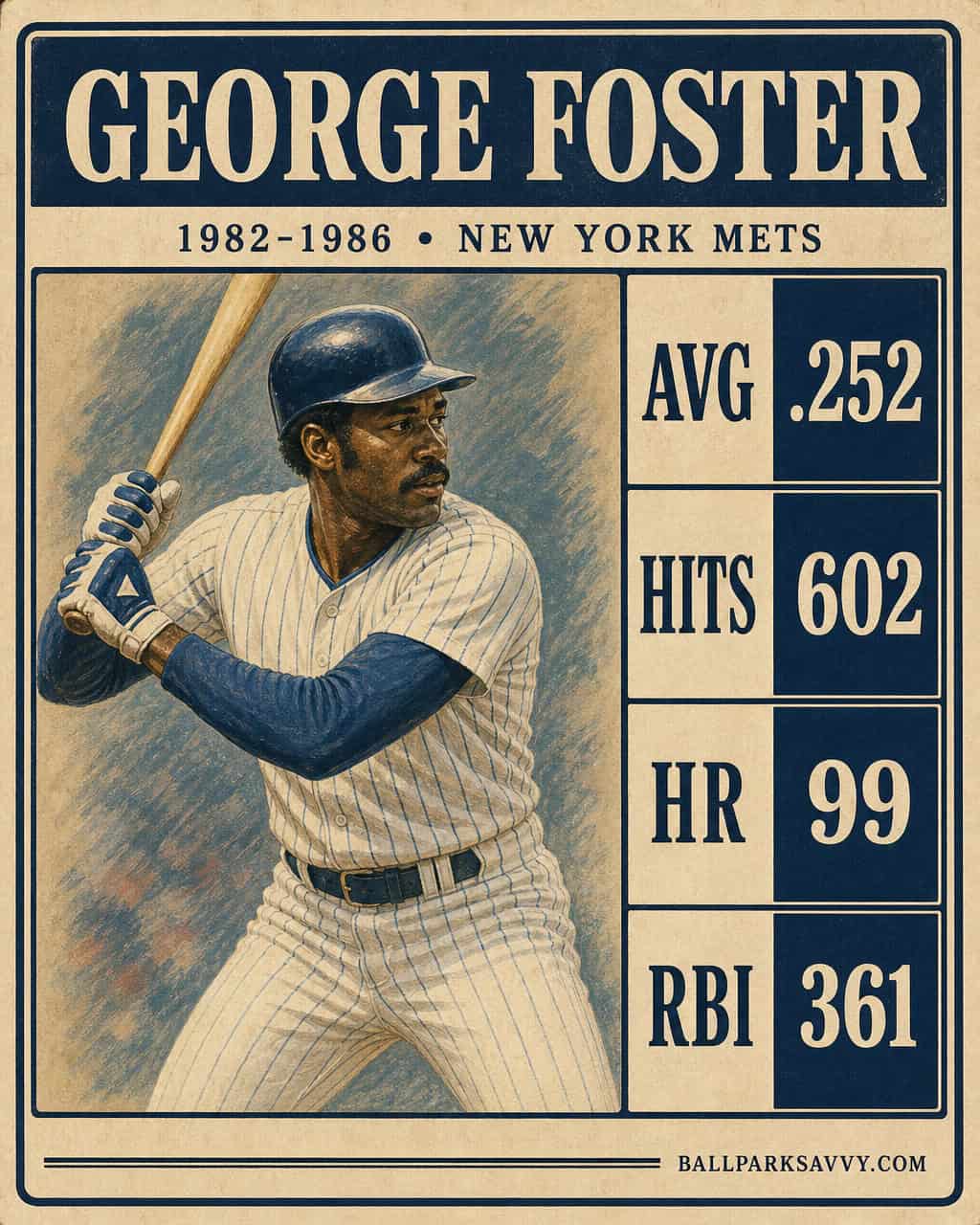
5. George Foster
1982-1986
| George Foster — Career | Total |
|---|---|
| G | 1977 |
| AB | 7023 |
| H | 1925 |
| HR | 348 |
| RBI | 1239 |
| SB | 51 |
| AVG | .274 |
| OBP | .338 |
| SLG | .480 |
| OPS | .818 |
| MVP | 1 |
| All-Star selections | 5 |
| Silver Sluggers | 1 |
| World Series titles | 2 |
Yes, George Foster is remembered as one of the great RBI men of his time. I don't know if many really remember his time with the New York Mets, though. He was an everyday starter, but brought a grand total of 4.7 WAR over four-and-a-half seasons.
It got to a point where the Mets just released him for lack of performance in 1986. We all know how that year ended up going for that team. Who knows what would have happened if Foster kept his roster spot?
4. Mo Vaughn
2002-2003
| Mo Vaughn — Career | Total |
|---|---|
| G | 1512 |
| AB | 5532 |
| H | 1620 |
| HR | 328 |
| RBI | 1064 |
| SB | 30 |
| AVG | .293 |
| OBP | .383 |
| SLG | .523 |
| OPS | .906 |
| MVP | 1 |
| All-Star selections | 3 |
| Silver Sluggers | 1 |
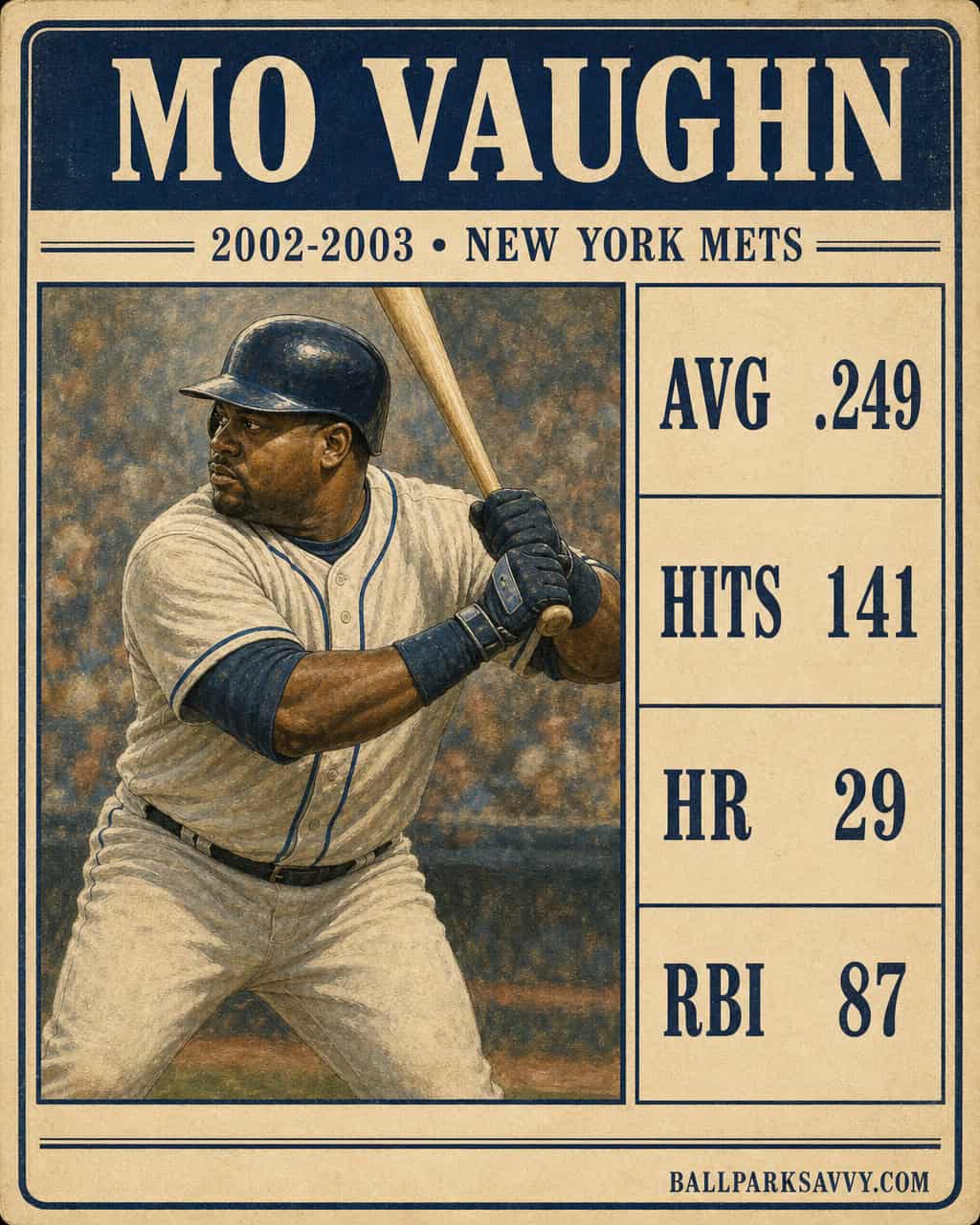
I'll be honest, I really liked watching Mo Vaughn play out the end of his career in the Big Apple. The numbers weren't eye-popping, which is why he has to be included on this list.
A guy who hit over 30 home runs in each of the last six seasons before he came to the Mets couldn't get to the 30-home-run mark in his two seasons in New York combined. They certainly didn't have the Mo Vaughn of old.
3. Gregg Jefferies
1987-1991
| Gregg Jefferies — Career | Total |
|---|---|
| G | 1465 |
| AB | 5520 |
| H | 1593 |
| HR | 126 |
| RBI | 663 |
| SB | 196 |
| AVG | .289 |
| OBP | .344 |
| SLG | .421 |
| OPS | .765 |
| All-Star selections | 2 |
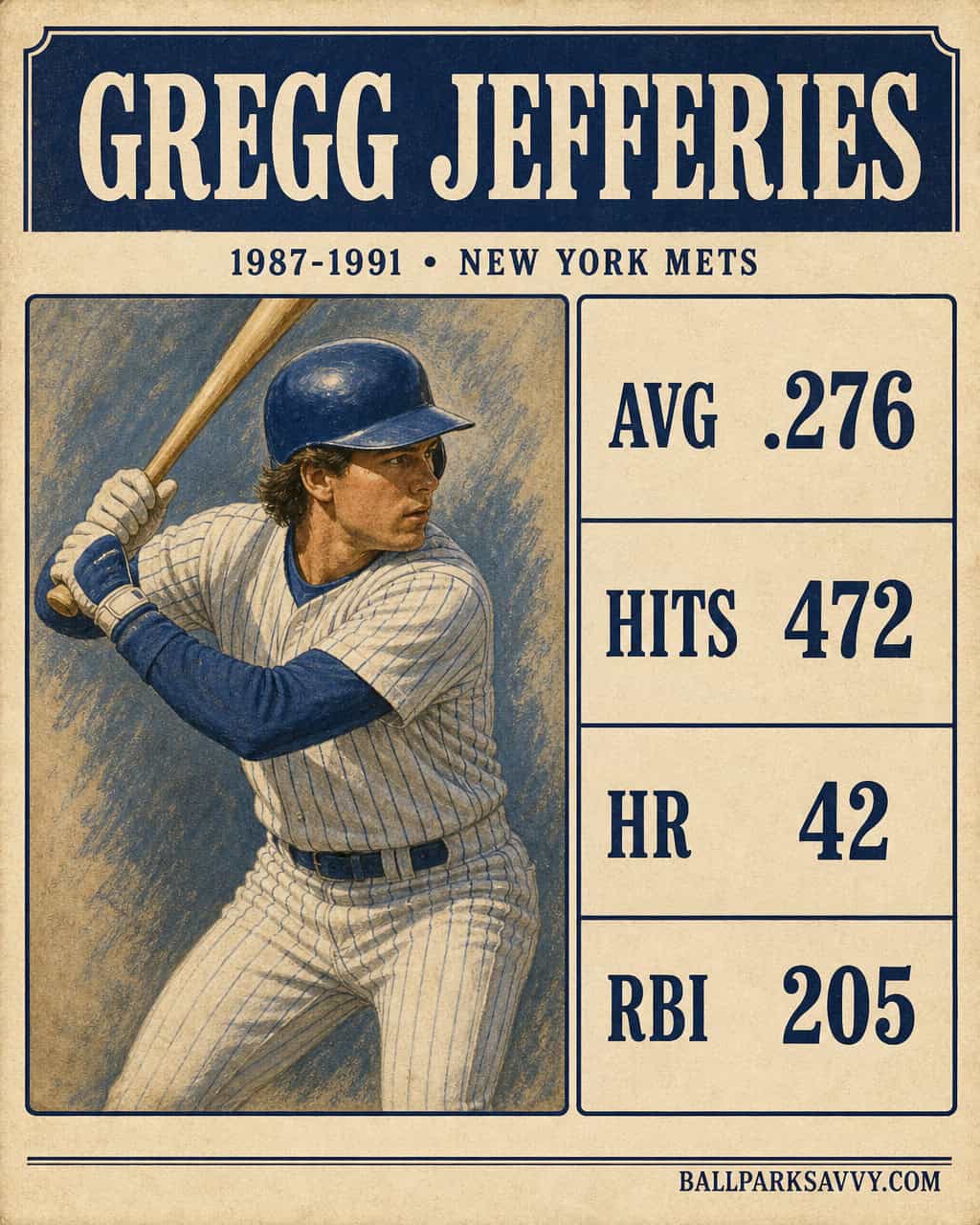
Gregg Jeffries had some solid numbers for the Mets in the years following their '86 championship. However, he found himself in Missouri, playing for the Royals in 1992 and the Cardinals in the two years after that. Those would end up being the most productive seasons of his career.
Even though he spent the longest time with the Mets, the statistical amounts that he was able to accumulate in Kansas City, St. Louis, and Philadelphia are much more impressive.
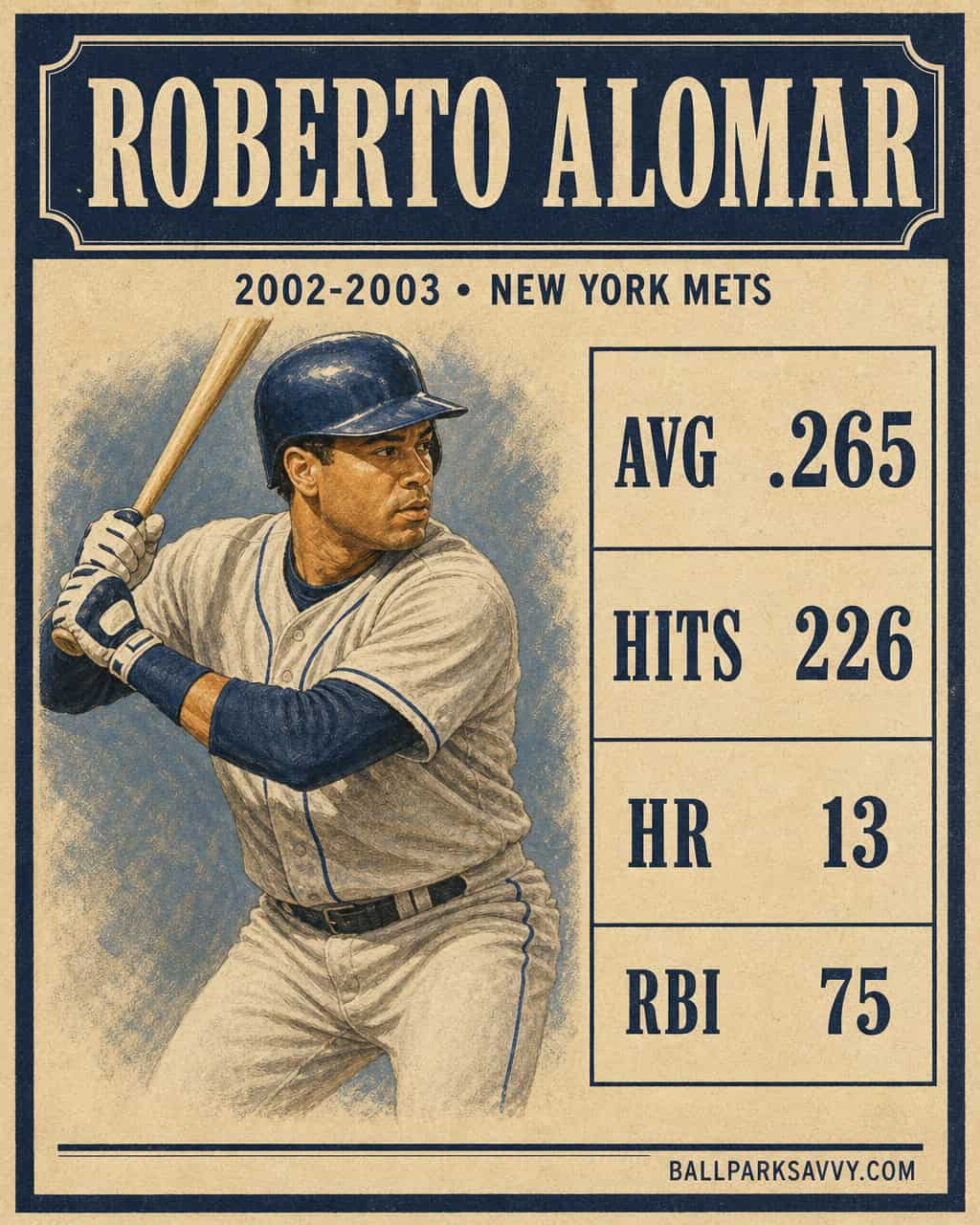
2. Roberto Alomar (HOF)
2002-2003
| Roberto Alomar — Career | Total |
|---|---|
| G | 2379 |
| AB | 9073 |
| H | 2724 |
| HR | 210 |
| RBI | 1134 |
| SB | 474 |
| AVG | .300 |
| OBP | .371 |
| SLG | .443 |
| OPS | .814 |
| All-Star selections | 12 |
| Gold Gloves | 10 |
| Silver Sluggers | 4 |
| World Series titles | 2 |
I feel like we've seen the Mets act like one of those teams that think that they're close to winning a championship and want to just add a veteran player to take them to the next level.
They thought they had that in Roberto Alomar. A .265 batting average with 0.4 WAR and 88 OPS+ helps to prove that he struggled to even get off the ground in Queens.
1. Bobby Bonilla
1992-1995, 1999
| Bobby Bonilla — Career | Total |
|---|---|
| G | 2113 |
| AB | 7213 |
| H | 2010 |
| HR | 287 |
| RBI | 1173 |
| SB | 45 |
| AVG | .279 |
| OBP | .358 |
| SLG | .472 |
| OPS | .830 |
| All-Star selections | 6 |
| Silver Sluggers | 3 |
| World Series titles | 1 |
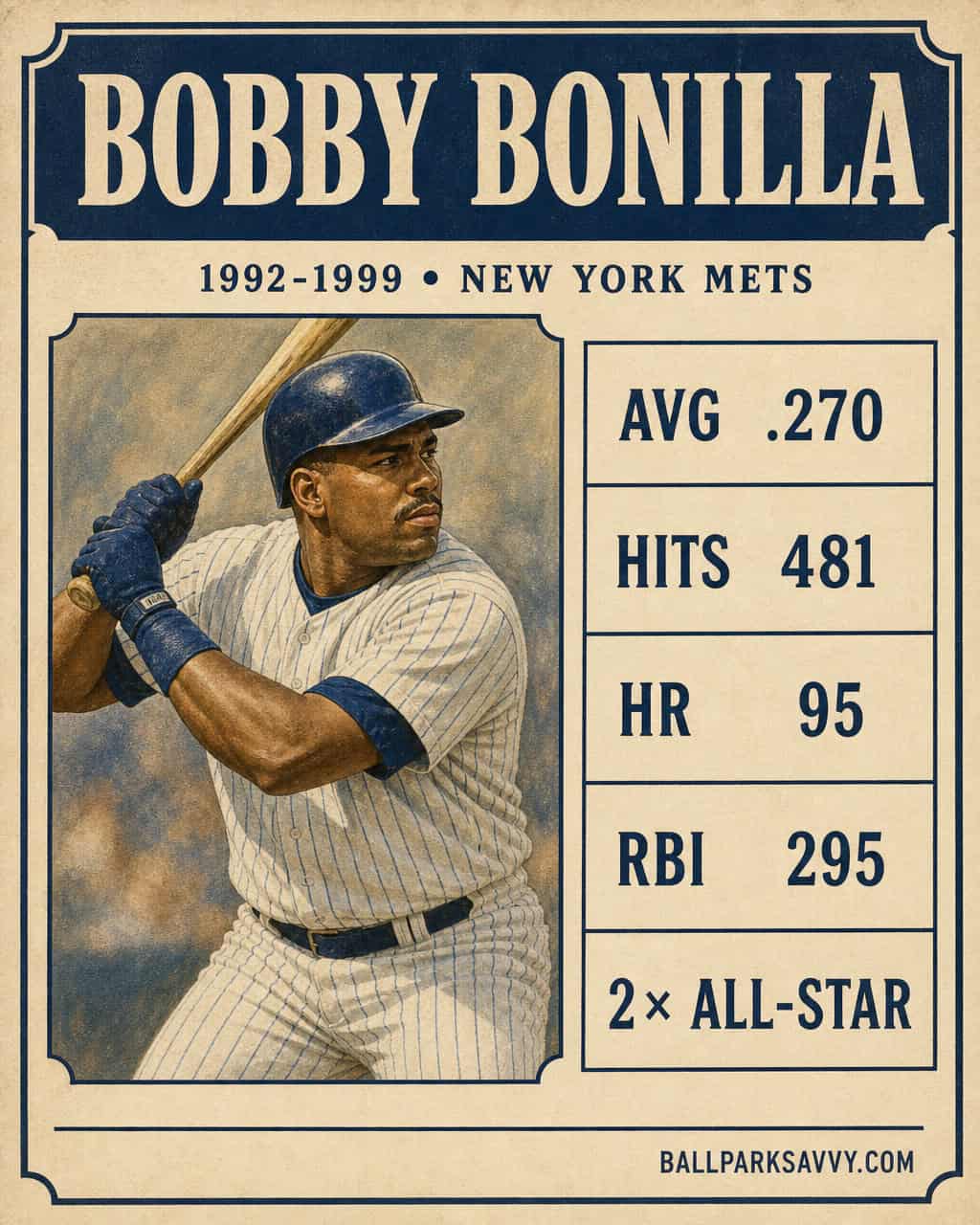
This will forever haunt the New York Mets organization. I don't think I have to be the one to tell you about the horrid deal they made with Bobby Bonilla in 1991. In a way, it's a cautionary tale for all of the other franchises across MLB.
I know that contract deferrals have worked for some of the brightest stars like Shohei Ohtani, but teams still have to have Bobby Bonilla Day in the back of their minds just so that they can avoid it themselves.
The Final Word
There was a plethora of talent all across this great list. I just want to mention that I have a great deal of respect for every single name covered here and that I was merely presenting the different perspectives that die-hard Mets fans may or may not be aware of.
Of course, we'll have to see if any more names need to be added in the future. Let us know if there are any we missed, and maybe we'll come back to this.