
20 Mets Who Got Way Too Much Credit

Share With Other Baseball Fans:

Last Updated: June 17th, 2026 by Michael Schatz

Being a Mets fan means loving players who break your heart, defending legends who maybe don’t deserve it, and laughing through the pain of contracts that still haunt the payroll years after retirement. This isn’t a list of the worst Mets ever—it’s something more complicated. These are the players whose reputations, whether inflated by nostalgia, hype, or one magical moment, exceeded what they actually delivered in Queens.

Don't lose this article. Enter your email below, and I'll send it to you right now. Plus, we'll send you other unbelievable stories from baseball's past.

Some names here will make you nod in bitter agreement (hello, Bobby Bonilla’s deferred money). Others will spark bar arguments that last until last call. A few were genuinely great players who simply didn’t live up to impossibly high expectations or whose Mets tenure gets mythologized beyond reality. The gap between reputation and production—that’s what we’re measuring. Not talent. Not likability. Not what they did in San Diego or Boston. What they did here, versus what we remember or what we were promised.

We’re counting down from #20 to #1, with the top spot reserved for the most overrated Met in franchise history. Let the arguments begin.

How We Made This List

We ranked these 20 players by the gap between the reputation or expectations they carried and what they actually delivered for the Mets. The comparison is limited to each player's time in Queens, weighing Mets production, durability, contract expectations, role, postseason contribution, and how strongly one memorable moment or a celebrated career elsewhere shaped the player's local reputation. This is an opinion ranking designed to spark debate, and the countdown preserves the source article's original editorial judgment.

20. Juan Soto

2025-present

Juan Soto — CareerTotal
G1180
AB4150
H1169
HR265
RBI749
SB102
AVG.282
OBP.416
SLG.532
OPS.948
All-Star selections5
Silver Sluggers6
World Series titles1

As a Met: 15-year, $765M contract signed Dec. 2024; .263/.396/.525, 43 HR, 105 RBI in the completed 2025 season.

The Mets handed Juan Soto a 15-year, $765 million contract in December 2024, the largest deal in the history of North American professional sports. At 26 years old and already a five-time All-Star, Soto is one of the best pure hitters of his generation. The question isn’t whether he’s elite—it’s whether anyone can be $51 million per year elite for the next decade and a half.

In his first season in Queens, Soto delivered a .263/.396/.525 slash line with 43 home runs, 105 RBI, and led the National League in both walks and stolen bases. Those are borderline MVP numbers for most players. For the highest-paid athlete in team sports history, they registered as vaguely disappointing—a strange verdict for a season that would represent a career year for 95 percent of the league.

The bar Soto needs to clear isn’t “great player.” It’s “best player on the planet, consistently, through 2039.” Anything less and the Mets will own one of baseball’s all-time payroll albatrosses. The jury won’t even be seated until 2028.

For now, Soto sits at number 20—not because he’s failed, but because the contract has created an expectation no human being may be able to meet. The legend was written before the first pitch.

19. Ed Kranepool

1962-1979

Ed Kranepool — CareerTotal
G1853
AB5436
H1418
HR118
RBI614
SB15
AVG.261
OBP.316
SLG.377
OPS.693
All-Star selections1
World Series titles1

As a Met: .261 AVG, 1,418 hits, 118 HR, 614 RBI, 1× All-Star as a Met

Ed Kranepool holds the franchise record for longevity — 18 seasons in Queens, from the original 1962 expansion club through the end of the ’70s. He’s remembered as the kid who signed at 17 and never left, a beloved clubhouse presence who remained an enduring link to the Polo Grounds Mets until his death on September 8, 2024, and who was still around when the team won it all in 1969.

The production, however, tells a different story. Across 1,853 games, Kranepool hit .261 with 118 home runs and 614 RBI — the line of a part-time first baseman and pinch-hitter, not a cornerstone. He made one All-Star team in nearly two decades. His best season, 1971, yielded a .280 average, 14 homers, and 58 RBI — solid, but hardly the stuff of franchise legend.

Kranepool debuted at 17 in 1962, appearing in three games and hitting .167. In 1975, he became a valuable part-time bat, hitting .323 with four home runs in 106 games. The tenure is unmatched; the career numbers were more ordinary than the longevity.

The reverence is real, and it’s rooted in loyalty and longevity. But the stats don’t justify the pedestal — they justify a plaque for service, not stardom.

18. Cleon Jones

1963-1975

Cleon Jones — CareerTotal
G1213
AB4263
H1196
HR93
RBI524
SB91
AVG.281
OBP.339
SLG.404
OPS.743
All-Star selections1
World Series titles1

As a Met: .281 AVG, 1,188 hits, 93 HR, 521 RBI, 1× All-Star as a Met

Mets Free-Agent Megadeals — Dollars Paid vs Mets-Era Output Gold = approximate millions paid. Navy = total Mets-tenure HR (pitchers shown with W). Lahman-sourced. Approx. dollars paid ($M) Mets HR / Pitcher Wins Mo Vaughn 33 29 Bobby Bonilla 29 95 Oliver Perez 36 29 Kaz Matsui 20 11 Vince Coleman 12 5 George Foster 10 99

Cleon Jones made the final catch of the 1969 World Series, kneeling in left field as the ball settled into his glove and the Miracle Mets completed their impossible run. That image, replayed endlessly, has cemented him as a franchise icon. His .340 batting average that season stood as the highest single-season mark in Mets history until John Olerud hit .354 in 1998, and no one disputes Jones earned his place in 1969 lore.

The problem is that one transcendent year has come to define a twelve-season career that was otherwise solidly ordinary. Jones hit .281 across 1,201 games in a Mets uniform, with 93 home runs and 521 RBI. His only All-Star selection came in 1969, and he never again approached that magical summer.

His next-best year, 1971, saw him hit .319 with 14 homers—a fine season, but not the stuff of legend. The surrounding campaigns blend into the middle of the pack, the kind of production you expect from a good everyday outfielder, not a franchise cornerstone.

The catch will always matter, and 1969 will always be sacred. But the nostalgia tide has lifted Jones’s overall reputation well beyond what ten ordinary seasons and one extraordinary one can objectively support.

17. Keith Hernandez

1983-1989

Keith Hernandez — CareerTotal
G2088
AB7370
H2182
HR162
RBI1071
SB98
AVG.296
OBP.384
SLG.436
OPS.820
MVP1
All-Star selections5
Gold Gloves11
Silver Sluggers2
World Series titles2

As a Met: .297 AVG, 939 hits, 80 HR, 468 RBI, 3× All-Star as a Met

Keith Hernandez is sacred ground in Queens. Six consecutive Gold Gloves, the captaincy of the 1986 champions, and a second act in the broadcast booth have cemented him as the thinking fan’s Met—cerebral, clutch, and indispensable to the franchise’s only sustained golden age.

The Mets-tenure batting line tells a different story: .297 average, 80 home runs, 468 RBI across seven seasons. Those are the numbers of a very good player, not a franchise cornerstone. His best year in New York—1984—produced 15 homers and 94 RBI and earned him a runner-up finish in National League MVP voting. The glove was elite, the baseball IQ undeniable, but the offensive production was that of a complementary star, not the engine.

The Hall of Fame case collapses under scrutiny. His career 60.3 WAR was mostly accumulated in St. Louis, where he won the 1979 MVP. The Mets got the tail end, and while it was a productive tail end, it wasn’t Cooperstown-worthy on its own.

Hernandez was the right player at the right time for the right team. That doesn’t make him what memory insists he was.

16. Bartolo Colon

2014-2016

Bartolo Colon — CareerTotal
W247
L188
ERA4.12
G565
IP3461.2
SO2535
WHIP1.31
SV0
Cy Young1
All-Star selections4

As a Met: 44-34 record, 3.90 ERA, 415 K in 588.2 IP, 1× All-Star as a Met

The Mets signed Bartolo Colon to a two-year, $20 million deal in 2014 expecting a durable veteran arm. What they got was a durable veteran arm — and the internet’s favorite meme. Big Sexy became a cult hero, his at-bats appointment viewing, his physique the subject of a thousand affectionate tweets.

The actual production was thoroughly ordinary. Across three seasons, Colon went 44-34 with a 3.90 ERA in 95 starts. That’s a perfectly cromulent back-of-rotation starter, the kind teams acquire for $7 million and forget about. He made one All-Star team, threw one complete game, and supplied 31 starts to the 2015 club that won the National League pennant.

On May 7, 2016, at age 42, Colon hit the only home run of his 21-year career. It was glorious. It was also the single most memorable thing he did in three years. The swing generated more highlight-reel value than any of his 415 strikeouts or 588 innings combined.

Bartolo Colon was hilarious. Bartolo Colon was also a fourth starter whose legend far outpaced his ledger. The merchandise still moves; the ERA still sits at 3.90.

15. Dave Kingman

1975-1977, 1981-1983

Dave Kingman — CareerTotal
G1941
AB6677
H1575
HR442
RBI1210
SB85
AVG.236
OBP.302
SLG.478
OPS.780
All-Star selections3

As a Met: .219 AVG, 509 hits, 154 HR, 389 RBI, 1× All-Star as a Met

Hyped Prospects vs Mets Reality Gold = pre-debut prospect rank (lower = more hyped). Navy = best single Mets season output (HR or W). Pre-debut prospect rank Best Mets season HR Gregg Jefferies 1 14 Matt Harvey 54 13 Noah Syndergaard 6 14 Kaz Matsui 4 7

Dave Kingman was the Mets’ answer to the moon shot, a towering slugger who could send baseballs into orbit and fill seats at Shea with the promise of tape-measure dingers. He reached 37 home runs twice as a Met and led the National League with that total in 1982, and fans forgave almost anything for the chance to see him connect. The franchise brought him back for a second stint in 1981, betting that 37-homer seasons were worth the baggage.

The problem was everything that happened between the home runs. Across six seasons in Queens, Kingman hit .219 with a .288 on-base percentage and struck out 672 times in 2,323 at-bats. In 1982, he tied his Mets single-season record with 37 homers but finished the year batting .204 with a .285 OBP, a line that somehow earned him 99 RBI and zero MVP votes of consequence.

He never started an All-Star Game as a Met, never cracked the top eight in MVP voting, and was a defensive liability who bounced between positions like a pinball. The home run column was spectacular. The nine other columns on the stat sheet told a different story.

Kingman gave Mets fans exactly one thing, and he gave it to them in breathtaking fashion. The question is whether one thing, no matter how majestic, was ever enough.

14. Lee Mazzilli

1976-1981, 1986-1989

Lee Mazzilli — CareerTotal
G1475
AB4124
H1068
HR93
RBI460
SB197
AVG.259
OBP.359
SLG.385
OPS.744
All-Star selections1
World Series titles1

As a Met: .264 AVG, 796 hits, 68 HR, 353 RBI, 1× All-Star as a Met

Lee Mazzilli was the face the Mets wanted in the late 1970s — the Brooklyn kid with matinee-idol looks, drafted 14th overall in 1973 and marketed as the homegrown star who would restore relevance to a franchise in freefall. He made one All-Star team in 1979, hitting a game-tying home run and drawing a bases-loaded walk that forced in the go-ahead run, moments that cemented his place in fan memory far beyond what the box scores would suggest.

Across ten seasons in a Mets uniform, Mazzilli hit .264 with 68 home runs and a .362 slugging percentage. His best year, 1979, saw him bat .303 with 15 homers and 79 RBI — solid production, but hardly the stuff of franchise cornerstone. He walked more than he struck out, played good defense, and stole bases, but the power never materialized and the consistency flickered.

The Mets traded him to Texas in 1982 for Ron Darling and Walt Terrell, a haul that tells you everything about how the front office valued him versus how the fans did. He returned in 1986 as a useful bench piece and won a ring, which only burnished the legend.

The Brooklyn accent and the All-Star Game heroics loom larger in Mets lore than the actual slash line. Beloved, yes. Irreplaceable on the field? The trade return suggests otherwise.

13. Marv Throneberry

1962-1963

Marv Throneberry — CareerTotal
G480
AB1186
H281
HR53
RBI170
SB3
AVG.237
OBP.311
SLG.416
OPS.727
World Series titles1

As a Met: .240 AVG, 89 hits, 16 HR, 50 RBI

Marvelous Marv Throneberry arrived in Queens six weeks into the 1962 expansion season as a 28-year-old first baseman who would become the franchise’s first folk hero—not despite his failures, but because of them. The Mets needed a power bat, and Throneberry delivered 16 home runs in his debut season, the kind of total that looked respectable in box scores if you didn’t watch the games.

The problem was everything else. He hit .244 with 88 strikeouts against just 89 hits, made errors at first base roughly once a week, and authored the most famous base-running disaster in franchise lore. In a key spot he tripled into the gap, only to be called out for missing first base—and when Casey Stengel came out to argue, the umpire waved him off because Throneberry had missed second base too.

By 1963 he was barely playing, finishing his Mets career with two hits in 14 at-bats before disappearing from the majors entirely. But the legend only grew: beer commercials, nostalgia tours, the patron saint of lovable losers.

The actual production was replacement-level at best. The reputation—eternal. That’s the Marvelous Marv paradox: he became a star precisely because he wasn’t one, and somehow that made him more overrated than any player who was simply bad.

12. Kaz Matsui

2004-2006

Kazuo Matsui — CareerTotal
G630
AB2302
H615
HR32
RBI211
SB102
AVG.267
OBP.321
SLG.380
OPS.701

As a Met: .256 AVG, 219 hits, 11 HR, 75 RBI

Revered Mets Veterans — What the Mets Actually Got Revered veterans can become Mets legends even when their Mets-tenure stat lines are good, not great. Player Mets tenure Mets-only stat line / overall context Keith Hernandez 1983-1989 NYM • 7 seasons .297 / 80 HR / 468 RBI as Met • 60.3 career WAR Roberto Alomar 2002-2003 NYM • 2 seasons .265 / 13 HR / 75 RBI as Met • 67.1 career WAR Mike Piazza 1998-2005 NYM • 8 seasons .296 / 220 HR / 655 RBI as Met • HoF 2016 Gary Carter 1985-1989 NYM • 5 seasons .249 / 89 HR / 349 RBI as Met • HoF 2003

The Mets signed Kaz Matsui to a three-year, $20 million deal in 2004 after he arrived from Japan as the 1998 Pacific League MVP and a seven-time Best Nine selection. The franchise handed him the shortstop job immediately, pushing 20-year-old José Reyes to second base where he promptly suffered a hamstring injury that would haunt him for two seasons. Matsui homered on the first pitch of his Mets debut, a moment that would stand as the high-water mark of his tenure.

Over three seasons in Queens, Matsui hit .256 with 11 home runs and 75 RBI across 239 games. He committed 24 errors as a rookie while hitting .272, moved to second base the following year after the Mets restored Reyes to shortstop, and was shipped to Colorado in 2006 after hitting .200 in limited duty. The numbers were serviceable role-player production, not franchise cornerstone material.

The cost extended beyond Matsui’s performance to the organizational decision that came with it. The Mets moved Reyes to second base in 2004 to make room for Matsui, then reversed the alignment in 2005 after Matsui failed to approach star level in New York.

The first-pitch homer was real. Everything the Mets hoped would follow never materialized.

11. Oliver Perez

2006-2010

Oliver Pérez — CareerTotal
W74
L94
ERA4.37
G703
IP1465.2
SO1546
WHIP1.43
SV5

As a Met: 29-29 record, 4.71 ERA, 494 K in 520.0 IP

The Mets saw Oliver Perez deliver six strong innings in Game 7 of the 2006 National League Championship Series against the Cardinals and decided they’d found their next ace. After he posted a 15-10 record with a 3.56 ERA in 2007 and followed with a 10-7, 4.22 ERA campaign in 2008, the front office brought him back on a three-year, $36 million contract. It was the kind of optimistic investment that defines a decade of Mets futility.

Perez repaid that faith with three wins, nine losses, and a 6.81 ERA across 2009 and 2010. His 2009 season ended after knee surgery, and in 2010 he was moved to the bullpen and refused a minor-league assignment. Across five seasons in Queens, he finished 29-29 with a 4.71 ERA and 301 walks in 520 innings—the kind of line that makes you wonder if anyone in the front office watched him pitch.

The Mets released him in 2011 while still owing $12 million, a parting gift that became an annual reminder of organizational dysfunction. Perez later resurrected his career as a lefty reliever elsewhere, proving he had value—just not $36 million worth, and definitely not in New York.

10. Luis Castillo

2007-2010

Luis Castillo — CareerTotal
G1720
AB6510
H1889
HR28
RBI443
SB370
AVG.290
OBP.368
SLG.351
OPS.719
All-Star selections3
Gold Gloves3
World Series titles1

As a Met: .274 AVG, 337 hits, 5 HR, 105 RBI

The Mets signed Luis Castillo to a four-year, $25 million deal in November 2007, envisioning a table-setter who’d swipe bags and get on base the way he had as a three-time All-Star with the Marlins and Twins. He was 32, a proven contact hitter with a career .290 average, and the Mets needed a leadoff man who could manufacture runs.

What they got was a .274 hitter with five home runs across four seasons and 365 games. Castillo stole 55 bases total in a Mets uniform—respectable, but hardly the dynamic threat his résumé promised. He walked more than he struck out, which kept his OBP afloat, but the power evaporated and the batting average dipped to .245 in 2008, his first full season in Queens.

And then came June 12, 2009, at Yankee Stadium: two outs, two on, ninth inning, Alex Rodriguez’s lazy pop-up drifting toward second base. Castillo camped under it, raised his glove, and dropped it. Both runners scored. Mets lost. The play became a Mets-fan trauma meme, replayed endlessly, a perfect encapsulation of the franchise’s late-2000s futility.

The contract was a smaller, slower-motion version of the same disappointment—four years of slap singles and diminishing returns, all for a player whose legacy in Queens is a single dropped ball.

9. Noah Syndergaard

2015-2021

Noah Syndergaard — CareerTotal
W59
L47
ERA3.71
G164
IP941.1
SO928
WHIP1.20
SV0
All-Star selections1

As a Met: 47-31 record, 3.32 ERA, 777 K in 718.0 IP, 1× All-Star as a Met

Infamous Mets Moments — Highlights and Lowlights Six moments fans remember more vividly than most of these players’ stat lines. Year Moment Outcome 1962 Marv Throneberry misses 1st AND 2nd base on a triple Folk hero born 1986 George Foster released mid-season Mets win WS without him 1993 Coleman throws firecracker into Dodger Stadium crowd Career-ending in NY 2000 Bonilla contract restructured into 25-year deferral Bobby Bonilla Day born 2009 Castillo drops A-Rod popup at Yankee Stadium 9th-inning lead lost 2016 Bartolo Colón’s only career HR, age 42 Beloved play of the decade

Noah Syndergaard was supposed to be the crown jewel of the R.A. Dickey trade, the 100-mph flamethrower who would anchor the Mets rotation for a decade alongside Matt Harvey and Jacob deGrom. The nickname Thor wasn’t ironic—it was aspirational, and for one glorious season in 2016, it felt earned.

Then came the reality check. Syndergaard posted exactly one elite season (14-9, 2.60 ERA in 2016) before injuries turned him into a cautionary tale about projecting durability from velocity. Over six seasons in Queens, he managed 120 starts in 121 appearances with a 47-31 record and a 3.32 ERA—solid numbers, but nowhere near the perennial Cy Young contender the organization envisioned when they traded a reigning award winner to acquire him.

Tommy John surgery cost him 2020 and most of 2021, and by the time he left as a free agent, the Mets had received one All-Star nod and a handful of what-ifs. The fastball was real, the hair was magnificent, and the nickname stuck around longer than the dominance.

The franchise bet on a decade of thunder and got one lightning strike followed by years of rumbling in the distance.

8. Matt Harvey

2012-2018

Matt Harvey — CareerTotal
W50
L66
ERA4.42
G180
IP966.1
SO867
WHIP1.29
SV0
All-Star selections1

As a Met: 34-37 record, 3.66 ERA, 612 K in 639.1 IP, 1× All-Star as a Met

Matt Harvey was supposed to be the franchise savior. The Dark Knight started the 2013 All-Star Game at 24, threw 100-mph heat with a slider that buckled knees, and became the face of the 2015 pennant run. Citi Field had never seen a homegrown ace quite like him.

The numbers tell a different story. Harvey went 34-37 with a 3.66 ERA across six seasons in Queens—respectable, but hardly ace-caliber over a full tenure. After Tommy John surgery derailed 2014, his ERA ballooned from 2.71 in 2015 to 4.86 in 2016 to a catastrophic 6.70 in 2017. The velocity never came back, and neither did the command.

By May 2018, the Mets traded him to Cincinnati for catcher Devin Mesoraco and cash after Harvey refused a minor league assignment. Three years earlier, he’d been the most-watched starter in baseball. The thoracic outlet syndrome, the late arrivals, the Manhattan nightclub headlines—all of it compounded the decline.

The hype was real, and so was the fall. Few Mets have ever carried a bigger spotlight for such a brief window of actual dominance.

7. Vince Coleman

1991-1993

Vince Coleman — CareerTotal
G1371
AB5406
H1425
HR28
RBI346
SB752
AVG.264
OBP.324
SLG.345
OPS.669
All-Star selections2
Rookie of the Year1

As a Met: .270 AVG, 238 hits, 5 HR, 63 RBI

The Mets signed Vince Coleman in 1991 expecting the man who’d topped 100 steals three times and led the National League in steals for six straight Cardinals seasons to transform their offense from the top of the order. They paid him $11.95 million over four years for that speed, that threat, that chaos on the basepaths that had terrorized the National League throughout the 1980s.

Instead they got 99 stolen bases across three injury-plagued seasons, an average of 33 per year after he had totaled 549 across his six league-leading Cardinals seasons. Coleman played just 72 games in his first Mets season thanks to hamstring issues, hit five home runs total in 880 at-bats, and posted a .270 average with an on-base percentage that barely cracked .330.

Then came July 24, 1993, when Coleman threw a lit M-100 firecracker into a crowd of autograph seekers outside Dodger Stadium, injuring three people including a two-year-old girl. The Mets ended his season and said he would not play for them again, then traded him to Kansas City in January 1994, ending one of the most disastrous free-agent signings in franchise history.

The Cardinals got a Hall of Fame–caliber base stealer. The Mets got 33 stolen bases per season and a criminal case.

6. Carlos Baerga

1996-1998

Carlos Baerga — CareerTotal
G1630
AB5439
H1583
HR134
RBI774
SB59
AVG.291
OBP.332
SLG.423
OPS.755
All-Star selections3
Silver Sluggers2

As a Met: .267 AVG, 283 hits, 18 HR, 116 RBI

Stars the Mets Acquired — Single-Season Peak Before vs After Gold = pre-NY career-high in a single season. Navy = best single Mets season. Same metric, both columns. Pre-NY single-season high Best Mets single-season Vince Coleman SB 110 38 George Foster HR 52 28 Mo Vaughn HR 44 26 R. Alomar HR 24 11 Carlos Baerga RBI 105 53

The Mets acquired Carlos Baerga in 1996 believing they were getting a three-time All-Star second baseman still in his prime. Cleveland’s run-producer had made three straight All-Star teams from 1992 through 1994 and topped 200 hits twice. The cost was steep: Jeff Kent and José Vizcaíno, two useful middle infielders shipped away for what looked like an immediate upgrade.

Baerga hit .193 with 2 home runs in his first 26 games as a Met (83 at-bats). The 1997 rebound was marginal—.281 with 9 homers and 52 RBI, respectable but nowhere near All-Star form. By 1998 he was a part-timer, and by age 30 he was essentially done as an everyday player.

Kent, meanwhile, went on to win an MVP and hit 377 career home runs. The trade became a textbook case study in paying for reputation over present value, a reminder that All-Star résumés don’t always travel well.

The Mets thought they were buying prime years. They got the beginning of the end, gift-wrapped in a Cleveland pedigree that no longer matched the player inside the uniform.

5. George Foster

1982-1986

George Foster — CareerTotal
G1977
AB7023
H1925
HR348
RBI1239
SB51
AVG.274
OBP.338
SLG.480
OPS.818
MVP1
All-Star selections5
Silver Sluggers1
World Series titles2

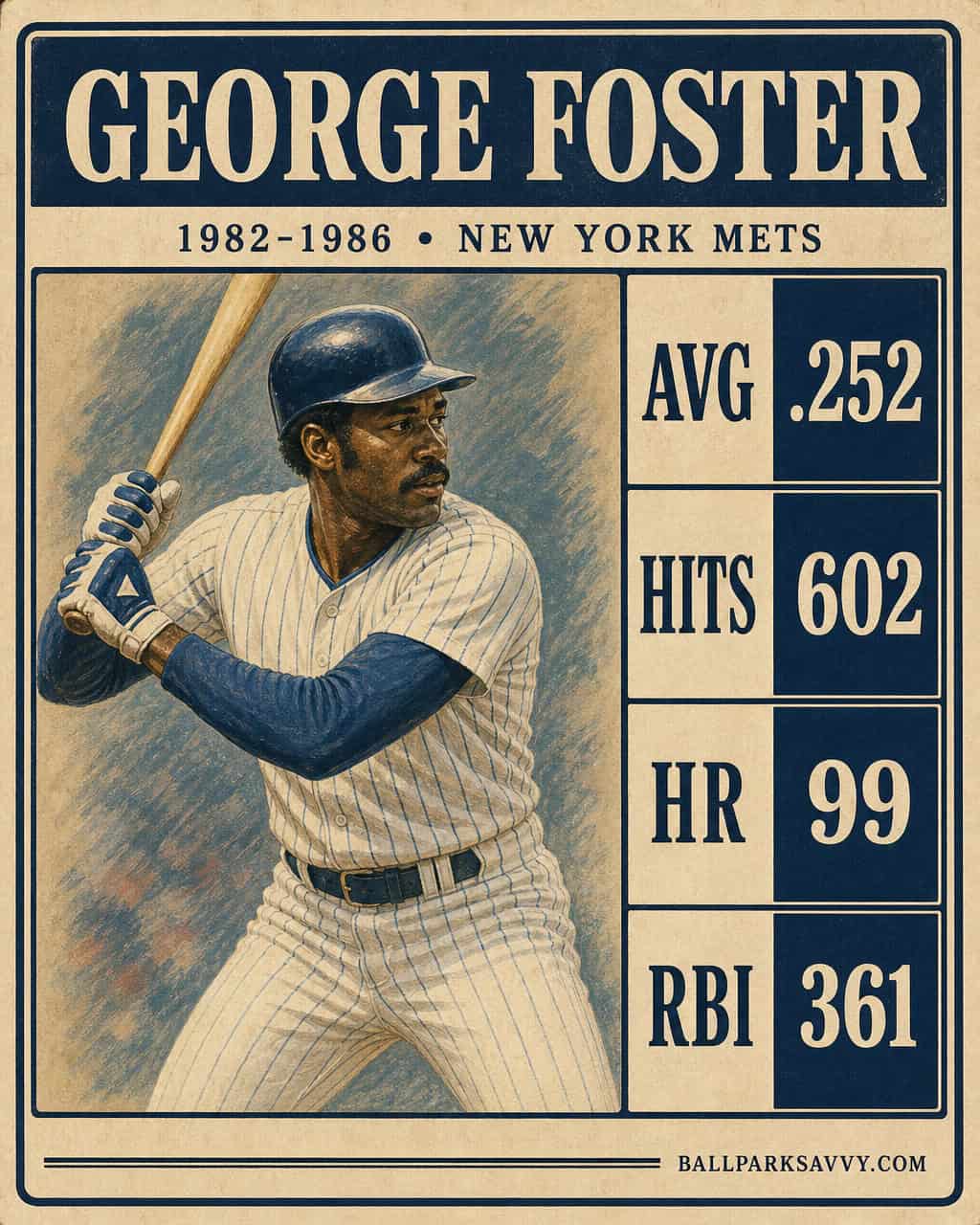
As a Met: .252 AVG, 602 hits, 99 HR, 361 RBI

George Foster stat card

The Mets didn’t just sign George Foster in 1982 — they made him the highest-paid player in baseball. They traded for a man who’d hit 52 home runs in a single season, a two-time World Series champion who’d terrorized National League pitching for a decade in Cincinnati. The expectation was simple: Foster would anchor the lineup and deliver the Mets back to relevance.

Instead, he hit .247 with 13 home runs in his first season, numbers that would’ve been disappointing for a utility player. Over five seasons in Queens, Foster managed a .252 average with 99 home runs — solid production, but nowhere near the superstar billing. His best year came in 1983 when he hit 28 homers, still a far cry from the 40-homer slugger the Mets thought they were getting.

By 1986, the relationship had deteriorated completely. Foster accused the team of benching him for racial reasons, was released within a week, and watched from home as the Mets won the World Series without him. He finished his Mets tenure hitting .227 in 72 games that final season.

The contract made headlines. The production made excuses. The gap between Cincinnati George Foster and Mets George Foster remains one of the widest in franchise history.

4. Mo Vaughn

2002-2003

Mo Vaughn — CareerTotal
G1512
AB5532
H1620
HR328
RBI1064
SB30
AVG.293
OBP.383
SLG.523
OPS.906
MVP1
All-Star selections3
Silver Sluggers1

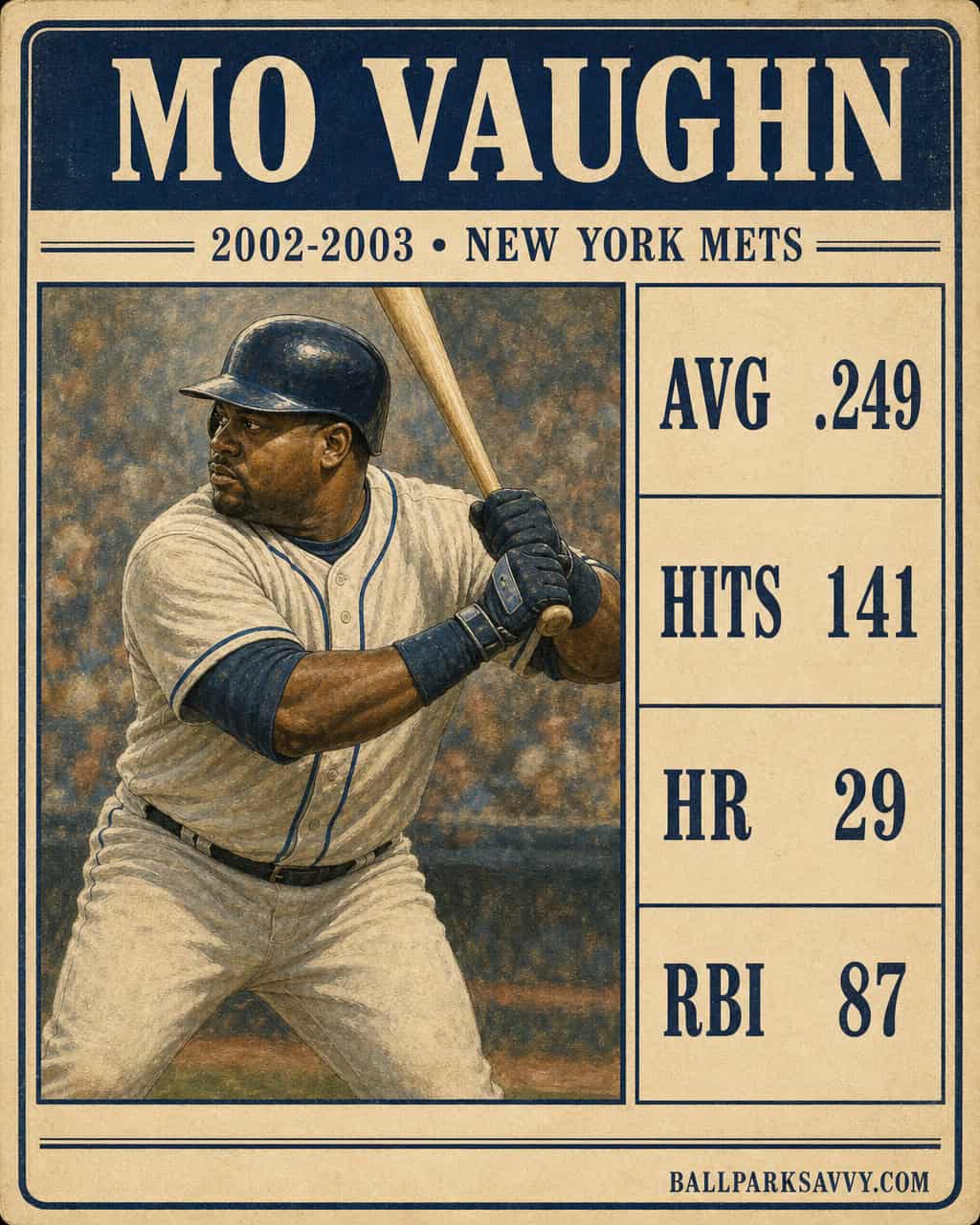
As a Met: .249 AVG, 141 hits, 29 HR, 87 RBI

Mo Vaughn stat card

The Mets acquired Mo Vaughn in December 2001 believing they were getting a former MVP and three-time All-Star who would anchor the middle of their lineup. Instead, they inherited the remaining obligations under the six-year, $80 million contract Vaughn had originally signed with the Angels, for a player who had missed an entire season with a torn biceps and reported to camp at 333 pounds.

Vaughn gave them 139 games in 2002, hitting .259 with 26 home runs and 72 RBI—respectable counting stats that came with a .456 slugging percentage and 145 strikeouts. The following year, chronic knee problems limited him to 27 games before ending his career at age 35.

Over two seasons in Queens, Vaughn appeared in 166 games total, batting .249 with 29 home runs while the Mets paid him roughly $33 million. His final Mets slash line of .249/.346/.438 represented one of the worst dollars-per-win investments in franchise history.

The Hit Dog was supposed to be the missing piece after the 2000 pennant. Instead, he became a cautionary tale about trading for injured sluggers on the wrong side of thirty.

3. Gregg Jefferies

1987-1991

Gregg Jefferies — CareerTotal
G1465
AB5520
H1593
HR126
RBI663
SB196
AVG.289
OBP.344
SLG.421
OPS.765
All-Star selections2

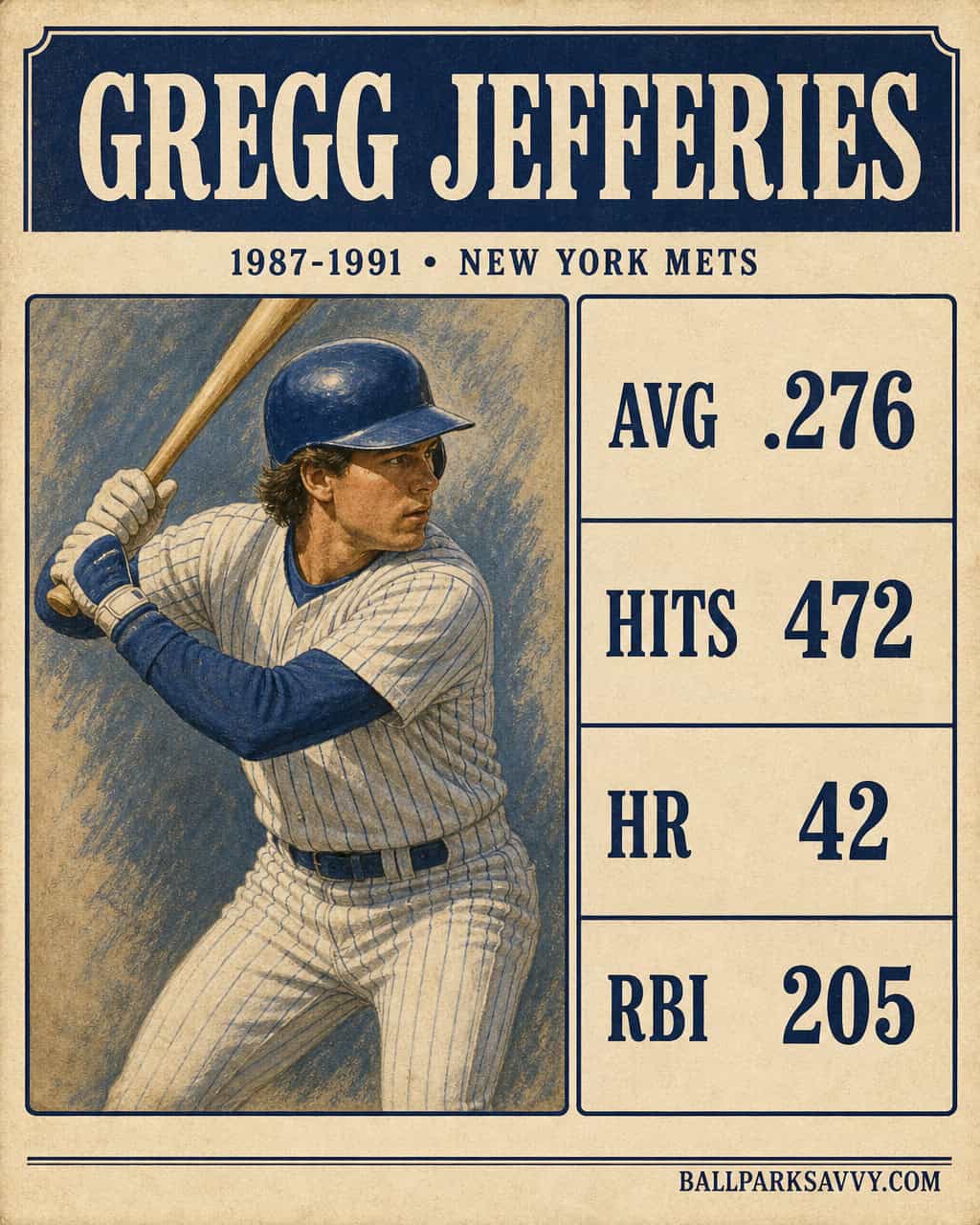
As a Met: .276 AVG, 472 hits, 42 HR, 205 RBI

Gregg Jefferies stat card
The Bobby Bonilla Deferred Payment How the Mets turned $5.9M into 25 annual checks of $1,193,248.20 $29M 5-year deal signed Dec 1991 $5.9M remaining money the Mets agreed to defer in 2000 8% annual interest rate baked into the deferral $29.8M total he’ll have collected by July 1, 2035 Bobby Bonilla Day — every July 1st, 2011 → 2035 2011 2035 25 × $1,193,248.20 Source: Cot’s Baseball Contracts

Gregg Jefferies arrived in Queens as the most-hyped prospect in baseball, a two-time Baseball America Minor League Player of the Year who graced prospect magazine covers. The Mets and their fans were promised the next offensive cornerstone, a generational bat who would anchor the lineup for a decade.

Instead, Jefferies delivered five seasons of solid-but-unspectacular production: a .276 average, 42 home runs, and 205 RBIs across 465 games. His best year, 1990, produced 15 homers and 68 RBIs with a .771 OPS—respectable numbers for a middle infielder, not the franchise-altering force the hype machine had advertised.

The clubhouse soured on him quickly. Veterans openly resented the preferential treatment management afforded their golden child, and by 1991 the Mets were eager to move on. They shipped him to Kansas City in the Bret Saberhagen deal, where he promptly became a two-time All-Star.

The irony stings: Jefferies wasn’t a bust, just a player whose New York reality never approached the mythology. Sometimes the story sells better than the stat line.

2. Roberto Alomar (HOF)

2002-2003

Roberto Alomar — CareerTotal
G2379
AB9073
H2724
HR210
RBI1134
SB474
AVG.300
OBP.371
SLG.443
OPS.814
All-Star selections12
Gold Gloves10
Silver Sluggers4
World Series titles2

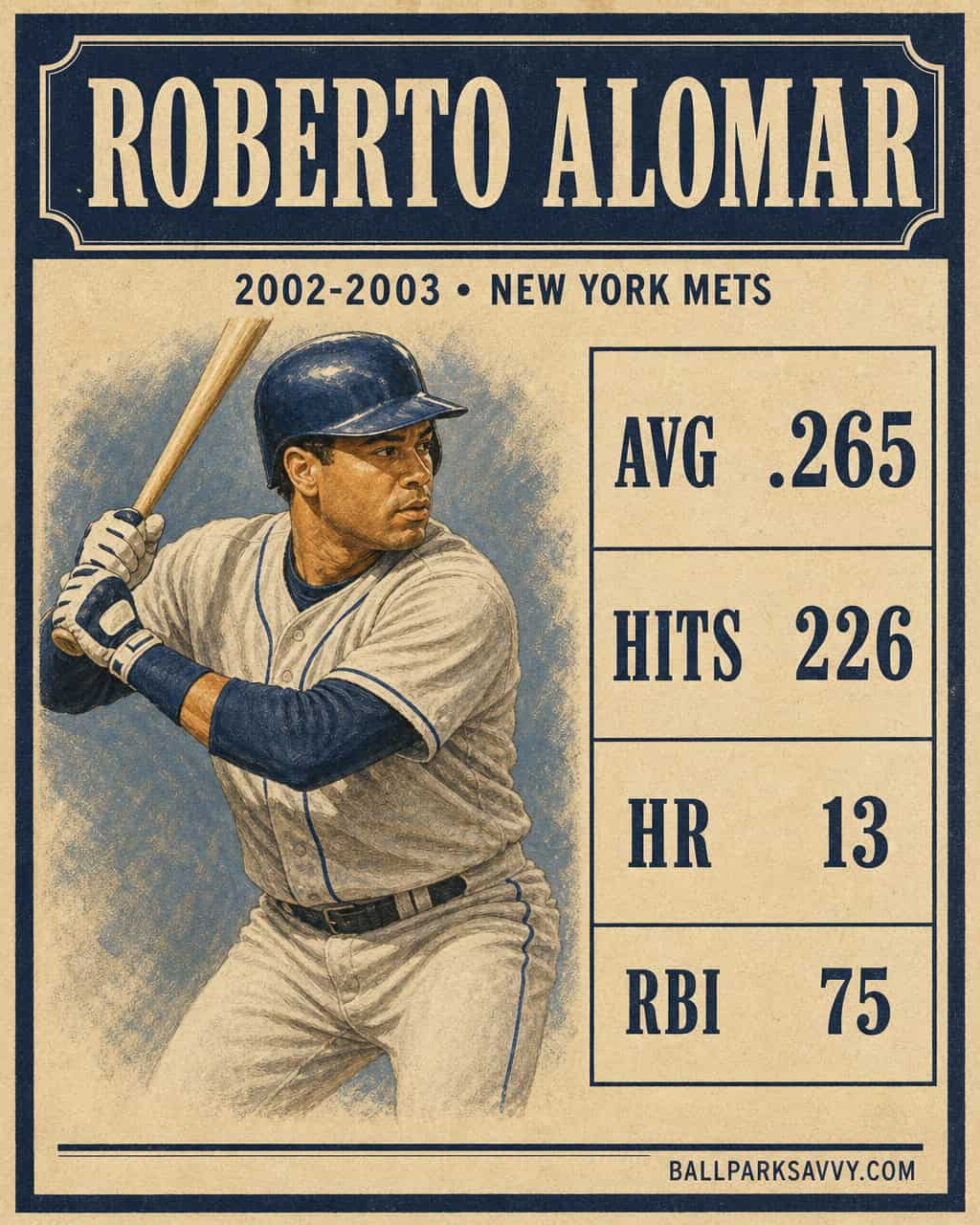
As a Met: .265 AVG, 226 hits, 13 HR, 75 RBI

Roberto Alomar stat card

The Mets acquired a 12-time All-Star and future Hall of Famer before the 2002 season, sending four players to Cleveland for the greatest defensive second baseman of his generation. Roberto Alomar was supposed to anchor the infield and bring championship pedigree to a franchise desperate for credibility.

Instead, Mets fans got two seasons of .265 batting and 13 total home runs across 222 games. The 2002 campaign produced career lows in nearly every rate stat, and by 2003 he managed just two home runs before the organization shipped him to the White Sox in July. The Gold Glove reputation remained, but neither his defense nor the bat that made him a perennial All-Star matched his prime years at Shea.

The trade cost the Mets Matt Lawton and three other players for what amounted to one mediocre season and half of another. Alomar’s Cooperstown plaque is well-deserved, but it commemorates his work in Toronto and Cleveland, not Queens.

The gap between Hall of Fame expectations and replacement-level production makes this one of the most lopsided star acquisitions in franchise history. The name carried more weight than the performance.

1. Bobby Bonilla

1992-1995, 1999

Bobby Bonilla — CareerTotal
G2113
AB7213
H2010
HR287
RBI1173
SB45
AVG.279
OBP.358
SLG.472
OPS.830
All-Star selections6
Silver Sluggers3
World Series titles1

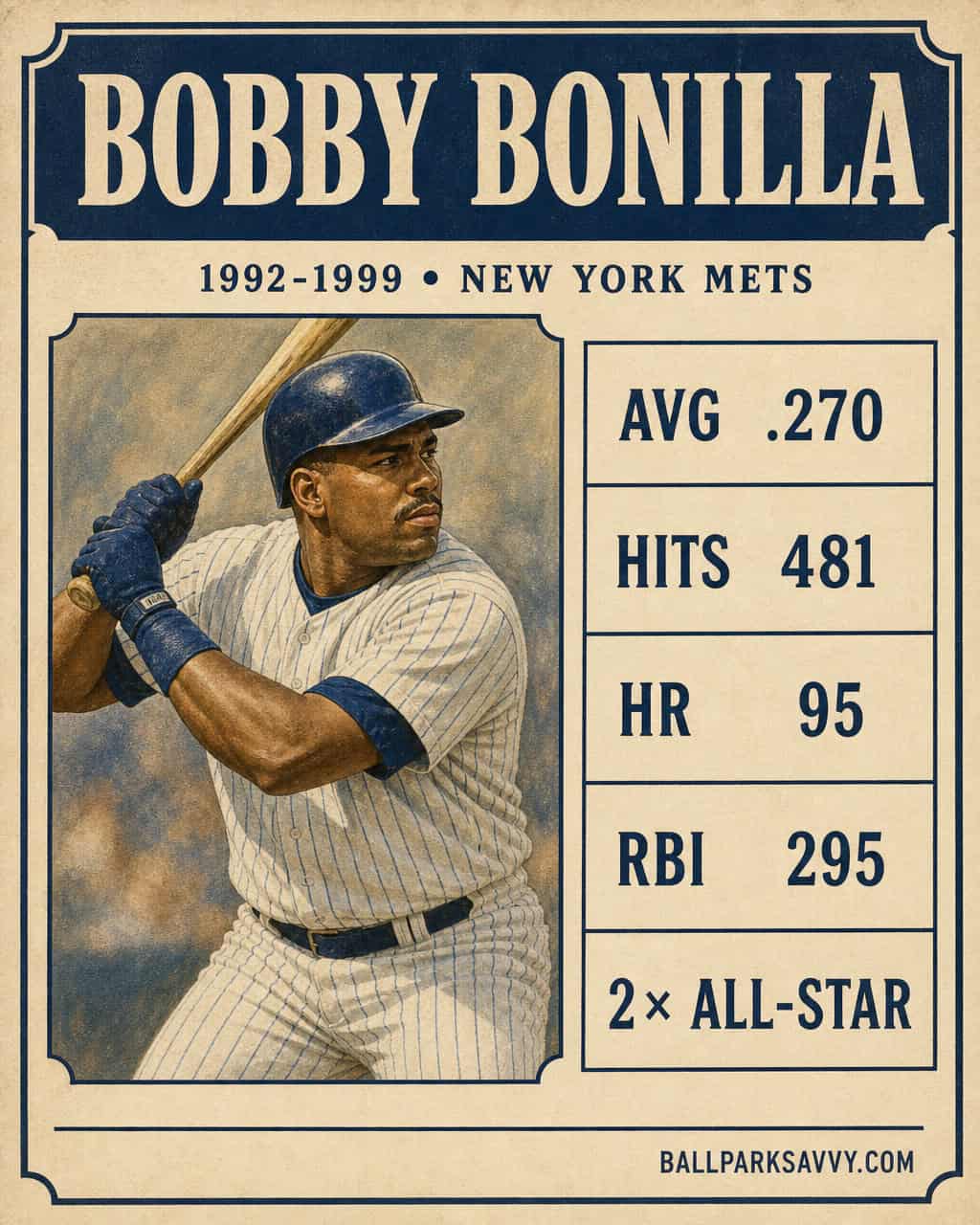
As a Met: .270 AVG, 481 hits, 95 HR, 295 RBI, 2× All-Star as a Met

Bobby Bonilla stat card

The Mets handed Bobby Bonilla a five-year, $29 million contract in December 1991, making him one of baseball’s highest-paid players. The front office envisioned a switch-hitting cornerstone who would anchor the lineup through the mid-nineties and deliver the kind of production he’d shown in Pittsburgh.

Instead, Bonilla gave them five seasons of .270 batting with 95 home runs and 295 RBI across 515 games—solid enough on paper, but nowhere near franchise-altering. His best year came in 1993 when he clubbed 34 homers and made the All-Star team, yet even that peak felt like table stakes for the contract, not a triumph. The clubhouse friction—feuds with managers, teammates, and the press—turned him into a lightning rod, and by 1999 the Mets were eager to move on.

What immortalized Bonilla wasn’t his Mets tenure but the deferred-payment deal the front office agreed to when they released him. The remaining $5.9 million ballooned into 25 annual checks of nearly $1.2 million, paid every July 1 from 2011 through 2035. The Wilpons expected Bernie Madoff returns to cover it. We all know how that math worked out.

Every Bobby Bonilla Day is a reminder that the legend of a player can outlive the production—especially when the checks keep clearing two decades after the last at-bat.

The Final Word

So there you have it. At #3, Gregg Jefferies embodied the biggest prospect hype of his generation but never delivered the generational bat Mets fans were promised. At #2, Roberto Alomar arrived as a Hall of Fame-caliber second baseman and collapsed the moment he put on the orange and blue. And claiming the top spot as the most overrated Met in franchise history: Bobby Bonilla, whose second Mets tenure ended with $5.9 million deferred into payments stretching to 2035, creating the signature embarrassment of an era.

This list was built to spark debate, not settle it. These are players we discussed—some fondly, others less so—not players we dismissed from memory. Every name here mattered enough to generate expectations, hype, or controversy. Now head back up to that trivia quiz and see how deep your Mets history really runs.

Keep reading