
Last Updated: June 17th, 2026 by Michael Schatz
The Mets have never been baseball’s glamour franchise, but they’ve given New York plenty of reasons to believe over six decades. From the lovable losers of 1962 to the Miracle Mets of ’69, from the swaggering champions of ’86 to the gritty contenders of the 2000s, this franchise has cycled through eras of triumph and heartbreak. The greatest players who wore the orange and blue didn’t just put up numbers—they defined what it meant to be a Met.
Don't lose this article. Enter your email below, and I'll send it to you right now. Plus, we'll send you other unbelievable stories from baseball's past.
This ranking evaluates players strictly on what they accomplished in Queens, not what they did before they arrived or after they left. A minimum of roughly three seasons or 10 WAR as a Met gets you in the conversation. That means we’re measuring Mike Piazza by his eight years behind the plate at Shea, not his Dodgers prime. It also means John Olerud’s outstanding three-year peak is weighed against the longer Mets careers of players such as David Wright and Ed Kranepool. Keith Hernandez, Darryl Strawberry, and Carlos Beltran all make strong cases from different eras.
We’re counting down from number 20 to number 1, ranking the players who mattered most when it mattered most—in a Mets uniform.
How We Made This List
We ranked these 20 hitters strictly by what they accomplished with the Mets, not by work for another club. The source puts roughly three Mets seasons or 10 Mets WAR in the conversation, then weighs offensive production, peak seasons, longevity, postseason impact, awards, defense, and importance to franchise history. The countdown preserves the source article's original editorial judgment, and reasonable fans may value peak performance and longevity differently.
20. Bobby Bonilla
1992-1995, 1999
| Bobby Bonilla — Career | Total |
|---|---|
| G | 2113 |
| AB | 7213 |
| H | 2010 |
| HR | 287 |
| RBI | 1173 |
| SB | 45 |
| AVG | .279 |
| OBP | .358 |
| SLG | .472 |
| OPS | .830 |
| All-Star selections | 6 |
| Silver Sluggers | 3 |
| World Series titles | 1 |
With the team: .270 AVG, 481 hits, 95 HR, 295 RBI, 2× All-Star
Bobby Bonilla arrived in Queens in 1992, played four seasons with the Mets through 1995, and returned for a second stint in 1999, serving as a power-hitting presence in the middle of the lineup. Over 515 games in a Mets uniform, he collected 481 hits and drove in 295 runs while launching 95 home runs.
His best season came in 1993 when he smashed 34 home runs and drove in 87 runs, providing the kind of production the franchise had envisioned when they signed him. He followed that with a .290 batting average in the strike-shortened 1994 campaign, then hit 20 home runs with 67 RBI.
Bonilla earned his two Mets All-Star selections in 1993 and 1995. After a 1995 trade to Baltimore, he returned to the Mets for 60 games in 1999 and hit .160 with four home runs and 18 RBI.
His tenure produced solid offensive numbers across five seasons, making him one of the more productive run producers during a transitional era for the franchise.
19. John Olerud
1997-1999
| John Olerud — Career | Total |
|---|---|
| G | 2234 |
| AB | 7592 |
| H | 2239 |
| HR | 255 |
| RBI | 1230 |
| SB | 11 |
| AVG | .295 |
| OBP | .398 |
| SLG | .465 |
| OPS | .863 |
| All-Star selections | 2 |
| Gold Gloves | 3 |
| World Series titles | 2 |
With the team: .315 AVG, 524 hits, 63 HR, 291 RBI
John Olerud anchored first base for the Mets from 1997 through 1999, bringing a rare combination of contact ability and defensive excellence to Flushing. Over three seasons, he compiled a .315 batting average with 524 hits and 291 RBI in 476 games. His 306 walks against just 206 strikeouts demonstrated exceptional plate discipline.
The 1998 campaign stands as Olerud’s masterpiece in a Mets uniform. He posted a .354 batting average with a .447 on-base percentage and .551 slugging percentage, setting franchise records for batting average and on-base percentage. His 197 hits that season paced a lineup that pushed toward October.
Olerud delivered clutch moments throughout his tenure, including a two-run walk-off home run on May 19, 1997, to beat the Colorado Rockies at Shea Stadium. In 1999, he played every game while hitting .298 with 96 RBI and 107 runs scored.
His three-year run produced the highest batting average of any Met with at least 1,500 at-bats in franchise history.
18. Tommie Agee
1968-1972
| Tommie Agee — Career | Total |
|---|---|
| G | 1130 |
| AB | 3912 |
| H | 999 |
| HR | 130 |
| RBI | 433 |
| SB | 167 |
| AVG | .255 |
| OBP | .320 |
| SLG | .412 |
| OPS | .732 |
| All-Star selections | 2 |
| Gold Gloves | 2 |
| World Series titles | 1 |
| Rookie of the Year | 1 |
With the team: .262 AVG, 632 hits, 82 HR, 265 RBI
Tommie Agee patrolled center field for the Mets from 1968 through 1972, anchoring the outfield during the franchise’s most improbable championship run. Over five seasons, he appeared in 661 games and hit 82 home runs with a .262 batting average while adding 92 stolen bases.
His 1969 season produced 26 home runs, 76 RBI, and 97 runs scored as the Miracle Mets captured their first World Series title. The following year, Agee posted career-best numbers with a .286 average, 24 home runs, 75 RBI, and 107 runs while earning a Gold Glove for his defensive excellence in center field.
Game 3 of the 1969 World Series showcased everything Agee brought to the Mets. He led off the game with a home run against the Orioles, then made two spectacular run-saving catches that preserved a 5-0 victory and shifted momentum in the Series.
No center fielder combined power, speed, and defense more effectively during the Mets’ first championship era than Agee.
17. Jerry Grote
1966-1977
| Jerry Grote — Career | Total |
|---|---|
| G | 1421 |
| AB | 4339 |
| H | 1092 |
| HR | 39 |
| RBI | 404 |
| SB | 15 |
| AVG | .252 |
| OBP | .316 |
| SLG | .326 |
| OPS | .642 |
| All-Star selections | 2 |
| World Series titles | 1 |
With the team: .256 AVG, 994 hits, 35 HR, 357 RBI, 2× All-Star
Jerry Grote anchored the Mets behind the plate from 1966 through 1977, appearing in 1,235 games across twelve seasons. He posted a .256 batting average with 994 hits and 357 RBI during his tenure in New York. Grote earned two All-Star selections with the Mets, in 1968 and 1974.
His defining contribution came in 1969, when he caught every postseason inning during the Miracle Mets’ improbable World Series run. That championship season saw Grote hit .252 with six home runs and 40 RBI, helping New York upset the Baltimore Orioles in the Fall Classic.
Grote’s best offensive seasons followed immediately after, recording 106 hits in 1970 and 109 hits in 1971 while batting .270 in the latter campaign. His steady presence behind the plate provided the foundation for the Mets’ pitching staff throughout their most successful era.
No catcher in franchise history has appeared in more games for the Mets than Grote’s 1,235.
16. Daniel Murphy
2008-2015
| Daniel Murphy — Career | Total |
|---|---|
| G | 1452 |
| AB | 5308 |
| H | 1572 |
| HR | 138 |
| RBI | 735 |
| SB | 68 |
| AVG | .296 |
| OBP | .341 |
| SLG | .455 |
| OPS | .796 |
| All-Star selections | 3 |
| Silver Sluggers | 2 |
With the team: .288 AVG, 967 hits, 62 HR, 402 RBI, 1× All-Star
Daniel Murphy spent seven seasons with the Mets from 2008 through 2015, establishing himself as a steady presence in the middle of the lineup. Over 903 games in a New York uniform, he collected 967 hits and posted a .288 batting average while driving in 402 runs.
Murphy’s 2015 postseason run remains one of the most electrifying stretches in franchise history. He won NLCS MVP after hitting .529 with four home runs and six RBI in the series against the Cubs, capping a run in which he set an MLB postseason record by homering in six consecutive playoff games.
His Game 5 performance against the Dodgers in the 2015 NLDS showcased both his baseball IQ and clutch hitting. Murphy took third base on a walk with heads-up baserunning, then delivered a go-ahead home run off Zack Greinke to send the Mets to the NLCS.
He earned one All-Star selection during his Mets tenure and posted his best season in 2013 with 188 hits, 13 home runs, and 78 RBI. Murphy’s October heroics in 2015 propelled the franchise to its first World Series appearance in fifteen years.
15. Bud Harrelson
1965-1977
| Bud Harrelson — Career | Total |
|---|---|
| G | 1533 |
| AB | 4744 |
| H | 1120 |
| HR | 7 |
| RBI | 267 |
| SB | 127 |
| AVG | .236 |
| OBP | .327 |
| SLG | .288 |
| OPS | .615 |
| All-Star selections | 2 |
| Gold Gloves | 1 |
| World Series titles | 1 |
With the team: .234 AVG, 1,029 hits, 6 HR, 242 RBI, 2× All-Star
Bud Harrelson patrolled shortstop for the Mets from 1965 through 1977, appearing in 1,322 games across 13 seasons. His glove defined his value more than his .234 batting average, though he collected 1,029 hits and drew 573 walks while stealing 115 bases in a Mets uniform.
Harrelson won the Gold Glove at shortstop in 1971, the same year he recorded 138 hits and earned TSN All-Star honors. He earned two All-Star selections with the Mets during his tenure.
His signature moment came in 1969 when he served as the starting shortstop for the Miracle Mets, anchoring the infield throughout their improbable World Series championship run. His two Mets All-Star selections came in 1970 and 1971; he remained the club’s shortstop as the Mets made another pennant push in 1973.
No shortstop in franchise history has played more games at the position for the Mets than Harrelson’s 1,322 appearances.
14. Carlos Delgado
2006-2009
| Carlos Delgado — Career | Total |
|---|---|
| G | 2035 |
| AB | 7283 |
| H | 2038 |
| HR | 473 |
| RBI | 1512 |
| SB | 14 |
| AVG | .280 |
| OBP | .383 |
| SLG | .546 |
| OPS | .929 |
| All-Star selections | 2 |
| Silver Sluggers | 3 |
With the team: .267 AVG, 468 hits, 104 HR, 339 RBI
Carlos Delgado anchored the middle of the Mets lineup from 2006 through 2009, providing veteran power as the team’s primary first baseman and cleanup hitter. Over four seasons in Queens, he launched 104 home runs and drove in 339 runs across 468 games.
His arrival in 2006 proved immediate and transformative. Delgado hit 38 home runs and drove in 114 runs while helping lead the Mets to the NL East championship in his first season with the club. On June 27, 2008, he set the franchise single-game RBI record by driving in nine runs against the Yankees.
Delgado matched his power output in 2008, again hitting 38 home runs while driving in 115 runs and batting .271. That season represented his final full campaign before injuries curtailed his career.
His off-field contributions earned recognition as well, as he received the Roberto Clemente Award in 2006 for his humanitarian work. Delgado remains the franchise’s single-game RBI record holder, a mark that has stood for nearly two decades.
13. Rusty Staub
1972-1975, 1981-1985
| Rusty Staub — Career | Total |
|---|---|
| G | 2951 |
| AB | 9720 |
| H | 2716 |
| HR | 292 |
| RBI | 1466 |
| SB | 47 |
| AVG | .279 |
| OBP | .362 |
| SLG | .431 |
| OPS | .793 |
| All-Star selections | 6 |
With the team: .276 AVG, 709 hits, 75 HR, 399 RBI
Rusty Staub spent nine seasons with the Mets across two separate stints from 1972 to 1985, serving as a reliable bat in the lineup and later as one of baseball’s most productive pinch-hitters. Over 942 games in a Mets uniform, he compiled 709 hits and 399 RBI while posting a .276 batting average.
His 1975 campaign stands as a franchise milestone. Staub became the first Mets player to reach 100 RBI in a season, finishing with 105 while adding 19 home runs and a .282 average. He collected 162 hits that year and scored 93 runs.
Staub’s second tenure with the club showcased his adaptability and clutch hitting off the bench. In 1983, he tied a major league record with 25 RBI as a pinch-hitter while batting .296 with 28 total RBI.
He played his final major league game on October 6, 1985, fittingly as a pinch-hitter for the Mets. Staub remains the only player in franchise history to drive in 100 runs in a season before the 1980s.
12. Mookie Wilson
1980-1989
| Mookie Wilson — Career | Total |
|---|---|
| G | 1403 |
| AB | 5094 |
| H | 1397 |
| HR | 67 |
| RBI | 438 |
| SB | 327 |
| AVG | .274 |
| OBP | .314 |
| SLG | .386 |
| OPS | .700 |
| World Series titles | 1 |
With the team: .276 AVG, 1,112 hits, 60 HR, 342 RBI
Mookie Wilson patrolled center field for the Mets from 1980 through 1989, appearing in 1,116 games across ten seasons. He collected 1,112 hits and stole 281 bases while batting .276, providing speed and energy at the top of the lineup throughout the decade.
Wilson swiped 54 bases and hit seven home runs for the Mets in 1983, giving the franchise a valuable speed-power combination. He followed that with a Mets career-high 10 home runs, 162 hits, and 88 runs scored in 1984, cementing his role as a catalyst in the Mets’ resurgence.
His defining moment arrived in Game 6 of the 1986 World Series, when his ground ball rolled through Bill Buckner’s legs in the tenth inning. That play helped the Mets force Game 7 and ultimately capture the franchise’s second championship.
Wilson remains the player most associated with the single most famous ground ball in franchise history.
11. Ed Kranepool
1962-1979
| Ed Kranepool — Career | Total |
|---|---|
| G | 1853 |
| AB | 5436 |
| H | 1418 |
| HR | 118 |
| RBI | 614 |
| SB | 15 |
| AVG | .261 |
| OBP | .316 |
| SLG | .377 |
| OPS | .693 |
| All-Star selections | 1 |
| World Series titles | 1 |
With the team: .261 AVG, 1,418 hits, 118 HR, 614 RBI, 1× All-Star
Ed Kranepool spent all 18 seasons of his major league career with the Mets from 1962 through 1979, serving as a first baseman and outfielder who became the franchise’s ultimate link to its origins. He made his debut as a 17-year-old with the inaugural 1962 Mets and remained the last player from that expansion team to stay with the organization and the last to retire from baseball altogether.
Kranepool appeared in 1,853 games for the Mets, a franchise record he set in 1974 and extended through the end of his career. He collected 1,418 hits and drove in 614 runs while posting a .261 batting average across nearly two decades in Queens.
His best season came in 1971 when he hit .280 with 14 home runs and 58 RBI. Kranepool appeared in 112 games during the 1969 championship season, contributing to the Mets’ first World Series title.
He earned one All-Star selection during his tenure with the club. No player wore a Mets uniform for more games than Kranepool’s 1,853 appearances across 18 seasons.
10. Cleon Jones
1963-1975
| Cleon Jones — Career | Total |
|---|---|
| G | 1213 |
| AB | 4263 |
| H | 1196 |
| HR | 93 |
| RBI | 524 |
| SB | 91 |
| AVG | .281 |
| OBP | .339 |
| SLG | .404 |
| OPS | .743 |
| All-Star selections | 1 |
| World Series titles | 1 |
With the team: .281 AVG, 1,188 hits, 93 HR, 521 RBI, 1× All-Star
Cleon Jones patrolled left field for the Mets from 1963 through 1975, establishing himself as one of the franchise’s most consistent hitters during its early years. Over 1,201 games in a Mets uniform, he collected 1,188 hits and posted a .281 batting average while driving in 521 runs.
His defining season came in 1969, when he hit .340 during the regular season and earned his lone All-Star selection with the club. Jones followed that performance by batting .357 in the World Series, helping the Mets capture their first championship.
He remained productive after the miracle season, hitting .319 with 161 hits in 1971. That campaign demonstrated his ability to sustain offensive excellence beyond the championship year.
Jones recorded 164 hits and scored 92 runs during the 1969 regular season, numbers that anchored the Mets’ lineup throughout their improbable run. His 93 home runs as a Met rank among the franchise’s early-era leaders.
Jones’s 1,201 Mets games and 1,188 hits remain among the franchise’s leading totals from its first championship era.
9. Edgardo Alfonzo
1995-2002
| Edgardo Alfonzo — Career | Total |
|---|---|
| G | 1506 |
| AB | 5385 |
| H | 1532 |
| HR | 146 |
| RBI | 744 |
| SB | 53 |
| AVG | .284 |
| OBP | .357 |
| SLG | .425 |
| OPS | .782 |
| All-Star selections | 1 |
| Silver Sluggers | 1 |
With the team: .292 AVG, 1,136 hits, 120 HR, 538 RBI, 1× All-Star
Edgardo Alfonzo anchored the Mets infield from 1995 through 2002, playing primarily second base during eight seasons in Queens. Over 1,086 games, he compiled a .292 batting average with 1,136 hits, 120 home runs, and 538 RBI while demonstrating exceptional plate discipline with 458 walks against just 498 strikeouts.
His 1999 campaign stands as one of the finest offensive seasons in franchise history. Alfonzo hit .304 with 27 home runs and 108 RBI while setting a Mets single-season record with 123 runs scored, earning him a Silver Slugger Award and an eighth-place finish in National League MVP voting.
He followed that breakout with an even better batting average in 2000, hitting .324 with 25 home runs and 94 RBI. That performance earned him his lone All-Star selection and helped propel the Mets to the National League pennant.
Alfonzo’s 212 doubles as a Met rank among the franchise’s all-time leaders at the position, cementing his status as the most productive offensive second baseman in team history.
8. Gary Carter (HOF)
1985-1989
| Gary Carter — Career | Total |
|---|---|
| G | 2296 |
| AB | 7971 |
| H | 2092 |
| HR | 324 |
| RBI | 1225 |
| SB | 39 |
| AVG | .262 |
| OBP | .335 |
| SLG | .439 |
| OPS | .774 |
| All-Star selections | 11 |
| Gold Gloves | 3 |
| Silver Sluggers | 5 |
| World Series titles | 1 |
With the team: .249 AVG, 542 hits, 89 HR, 349 RBI, 4× All-Star
Gary Carter arrived in New York via trade before the 1985 season and immediately transformed the Mets’ lineup from behind the plate. Over five seasons from 1985 to 1989, he appeared in 600 games and drove in 349 runs while launching 89 home runs. He earned four All-Star selections in a Mets uniform and won back-to-back Silver Slugger awards in 1985 and 1986.
Carter homered in his Mets debut on April 9, 1985, setting the tone for a breakout first season in New York. He finished that year with 32 home runs and 100 RBI, earning a sixth-place finish in National League MVP voting.
The 1986 season brought Carter his first World Series championship with the Mets, where he hit 24 home runs and drove in 105 runs during the regular season. He added another Silver Slugger to his collection that year, cementing his status as the league’s premier offensive catcher.
Carter’s immediate impact and sustained excellence across five seasons made him one of the franchise’s most accomplished catchers and a central figure in its 1986 championship, the Mets’ most recent World Series title.
7. Howard Johnson
1985-1993
| Howard Johnson — Career | Total |
|---|---|
| G | 1531 |
| AB | 4940 |
| H | 1229 |
| HR | 228 |
| RBI | 760 |
| SB | 231 |
| AVG | .249 |
| OBP | .340 |
| SLG | .446 |
| OPS | .786 |
| All-Star selections | 2 |
| Silver Sluggers | 2 |
| World Series titles | 2 |
With the team: .251 AVG, 997 hits, 192 HR, 629 RBI, 2× All-Star
Howard Johnson manned third base for the Mets from 1985 through 1993, establishing himself as one of the franchise’s most productive power threats. Over nine seasons, he collected 192 home runs and 202 stolen bases, a rare combination that defined his value at the hot corner.
His 1989 campaign earned him a Silver Slugger award after he hit 36 home runs with 101 RBI and a .287 batting average. Two years later in 1991, Johnson set the Mets’ single-season franchise record with 38 home runs while driving in 117 runs and scoring 108 times.
Johnson contributed to the 1986 World Series championship team and made two All-Star appearances during his Mets tenure. In 1987, his 36 home runs set the National League record for a switch hitter at the time.
His 192 home runs remain the most by any switch hitter in franchise history.
6. Jose Reyes
2003-2011, 2016-2018
| José Reyes — Career | Total |
|---|---|
| G | 1877 |
| AB | 7552 |
| H | 2138 |
| HR | 145 |
| RBI | 719 |
| SB | 517 |
| AVG | .283 |
| OBP | .334 |
| SLG | .427 |
| OPS | .761 |
| All-Star selections | 4 |
| Silver Sluggers | 1 |
With the team: .282 AVG, 1,534 hits, 108 HR, 521 RBI, 4× All-Star
Jose Reyes spent 12 seasons with the Mets across two stints from 2003 to 2018, establishing himself as the franchise’s premier shortstop and leadoff catalyst. He appeared in 1,365 games and collected 1,534 hits while batting .282 with 408 stolen bases in a Mets uniform.
His 2006 campaign stands as his signature season in Queens, when he hit .300 with 194 hits and 122 runs while earning Silver Slugger honors and his first of four All-Star selections with the team. He followed with consecutive years of excellence, scoring 119 runs in 2007 and recording 204 hits in 2008.
Reyes broke Mookie Wilson’s franchise record for career triples on July 20, 2008, against Cincinnati, eventually finishing with 113 triples as a Met. In 2011, he became the first batting champion in franchise history, cementing a legacy few shortstops in team annals can match.
His 408 stolen bases and 113 triples represent franchise records that may stand for generations.
5. Carlos Beltran (HOF)
2005-2011
| Carlos Beltrán — Career | Total |
|---|---|
| G | 2586 |
| AB | 9768 |
| H | 2725 |
| HR | 435 |
| RBI | 1587 |
| SB | 312 |
| AVG | .279 |
| OBP | .350 |
| SLG | .486 |
| OPS | .836 |
| All-Star selections | 9 |
| Gold Gloves | 3 |
| Silver Sluggers | 2 |
| World Series titles | 1 |
| Rookie of the Year | 1 |
With the team: .280 AVG, 878 hits, 149 HR, 559 RBI, 5× All-Star
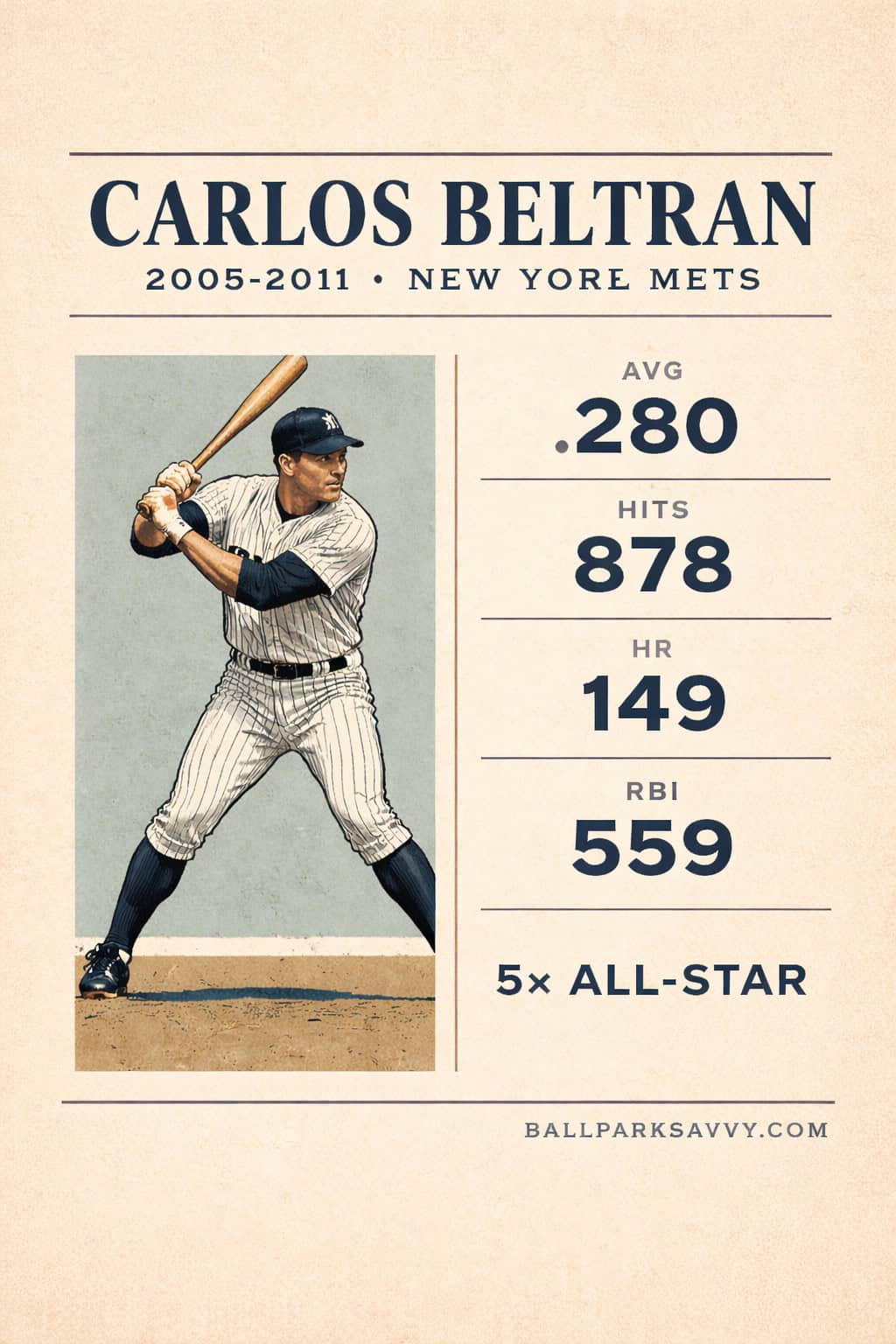
Carlos Beltran patrolled center field for the Mets from 2005 through 2011, establishing himself as one of the franchise’s most productive offensive forces. Over seven seasons, he collected 149 home runs and 559 RBI while maintaining a .280 batting average across 839 games.
His 2006 campaign stands as the centerpiece of his Mets tenure. Beltran hit 41 home runs that year, tying Todd Hundley’s then-franchise record, while driving in 116 runs and scoring 127 times. He added three home runs in the postseason as the Mets reached Game 7 of the NLCS.
Beltran’s excellence extended beyond the plate. He won three consecutive Gold Glove awards from 2006 through 2008 and earned Silver Slugger honors in both 2006 and 2007. His five All-Star selections with the Mets reflected his sustained dominance throughout the second half of the decade.
Inducted into the Hall of Fame in 2026, Beltran combined power, speed, and defensive excellence during his prime years in Queens.
4. Keith Hernandez
1983-1989
| Keith Hernandez — Career | Total |
|---|---|
| G | 2088 |
| AB | 7370 |
| H | 2182 |
| HR | 162 |
| RBI | 1071 |
| SB | 98 |
| AVG | .296 |
| OBP | .384 |
| SLG | .436 |
| OPS | .820 |
| MVP | 1 |
| All-Star selections | 5 |
| Gold Gloves | 11 |
| Silver Sluggers | 2 |
| World Series titles | 2 |
With the team: .297 AVG, 939 hits, 80 HR, 468 RBI, 3× All-Star
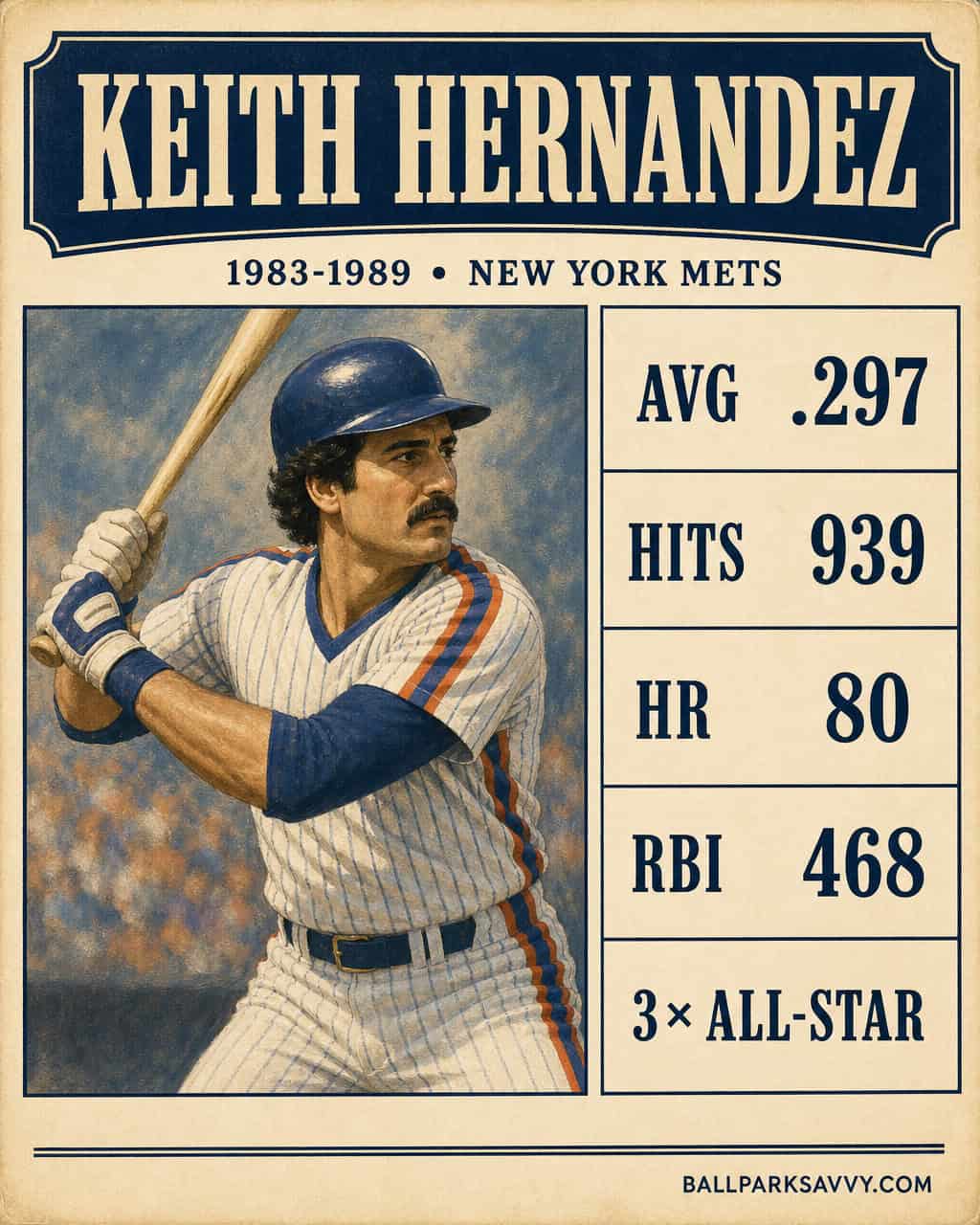
Keith Hernandez anchored first base for the Mets from 1983 through 1989, transforming the franchise’s defensive identity and offensive consistency. Over seven seasons, he appeared in 880 games and compiled a .297 batting average with 939 hits and 468 RBI in a Mets uniform.
His defensive excellence defined the era—Hernandez won six consecutive Gold Glove Awards from 1983 through 1988, beginning the streak in his first season with the club. He earned three All-Star selections and a Silver Slugger Award in 1984, when he hit .311 with 94 RBI.
The 1986 championship season showcased Hernandez at his peak, as he batted .310 with a .413 on-base percentage and 83 RBI while anchoring the World Series-winning roster. He went 6-for-26 with four RBI in the Fall Classic as the Mets defeated Boston in seven games.
No first baseman in franchise history combined his defensive mastery with sustained offensive production across an entire championship window.
3. Darryl Strawberry
1983-1990
| Darryl Strawberry — Career | Total |
|---|---|
| G | 1583 |
| AB | 5418 |
| H | 1401 |
| HR | 335 |
| RBI | 1000 |
| SB | 221 |
| AVG | .259 |
| OBP | .357 |
| SLG | .505 |
| OPS | .862 |
| All-Star selections | 8 |
| Silver Sluggers | 2 |
| World Series titles | 3 |
| Rookie of the Year | 1 |
With the team: .263 AVG, 1,025 hits, 252 HR, 733 RBI, 7× All-Star
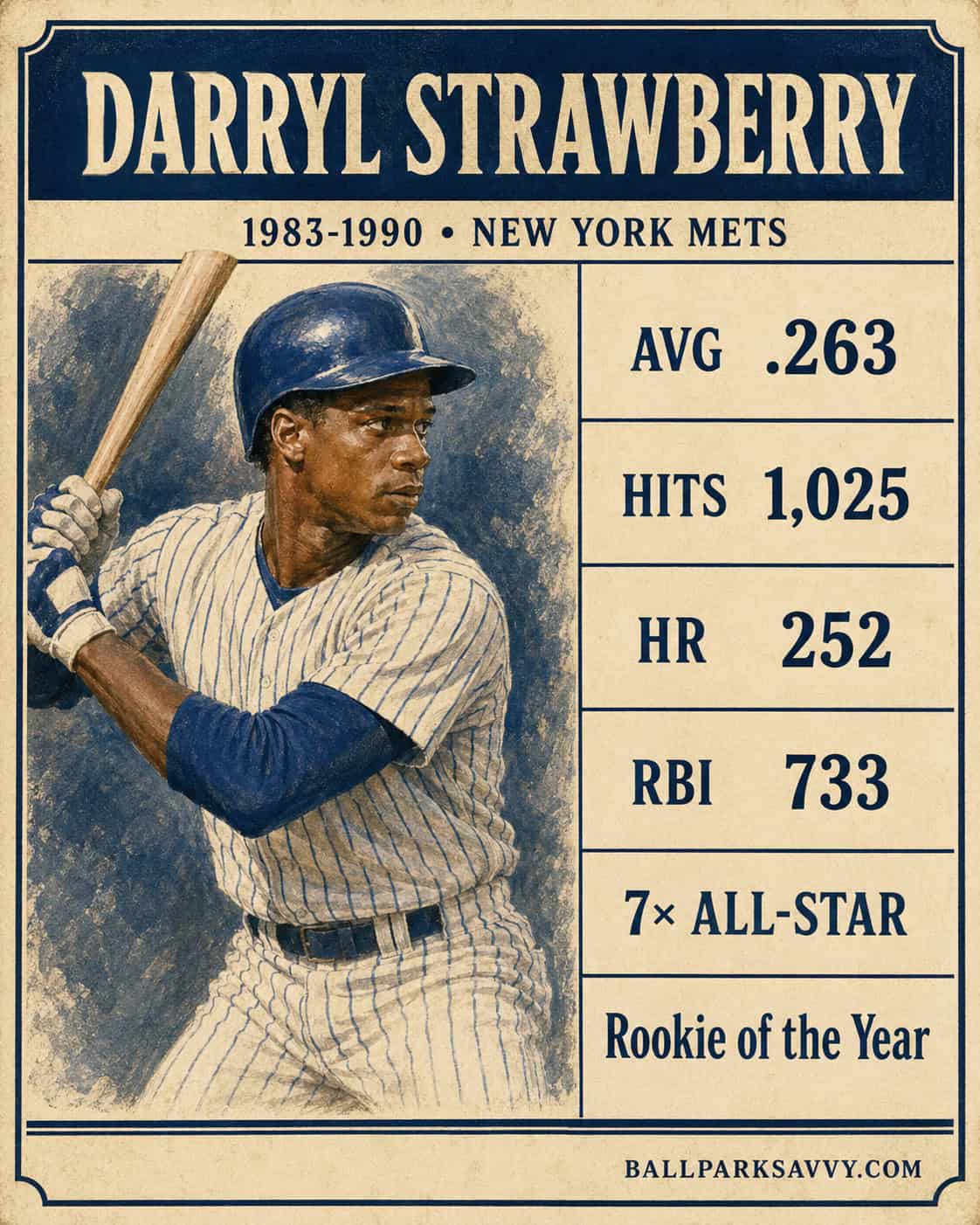
Darryl Strawberry patrolled right field for the Mets from 1983 through 1990, establishing himself as the franchise’s most dangerous power threat of the decade. He won the National League Rookie of the Year award in 1983 and earned seven All-Star selections during his eight seasons in Queens. Over 1,109 games in a Mets uniform, Strawberry launched 252 home runs and drove in 733 runs while adding 191 stolen bases.
His peak years came in consecutive seasons from 1987 through 1988, when he hit 39 home runs in both campaigns. In 1987 he drove in 104 runs and scored 108 times, then followed with 101 RBI and 101 runs scored the next year while earning a Silver Slugger award. He captured another Silver Slugger in 1990 with 37 homers and 108 RBI.
Strawberry helped the Mets win the 1986 World Series and played a key role when the club captured another NL East title in 1988. No player in franchise history has hit more home runs in a Mets uniform than Strawberry’s 252.
2. Mike Piazza (HOF)
1998-2005
| Mike Piazza — Career | Total |
|---|---|
| G | 1912 |
| AB | 6911 |
| H | 2127 |
| HR | 427 |
| RBI | 1335 |
| SB | 17 |
| AVG | .308 |
| OBP | .377 |
| SLG | .545 |
| OPS | .922 |
| All-Star selections | 12 |
| Silver Sluggers | 10 |
| Rookie of the Year | 1 |
With the team: .296 AVG, 1,028 hits, 220 HR, 655 RBI, 7× All-Star
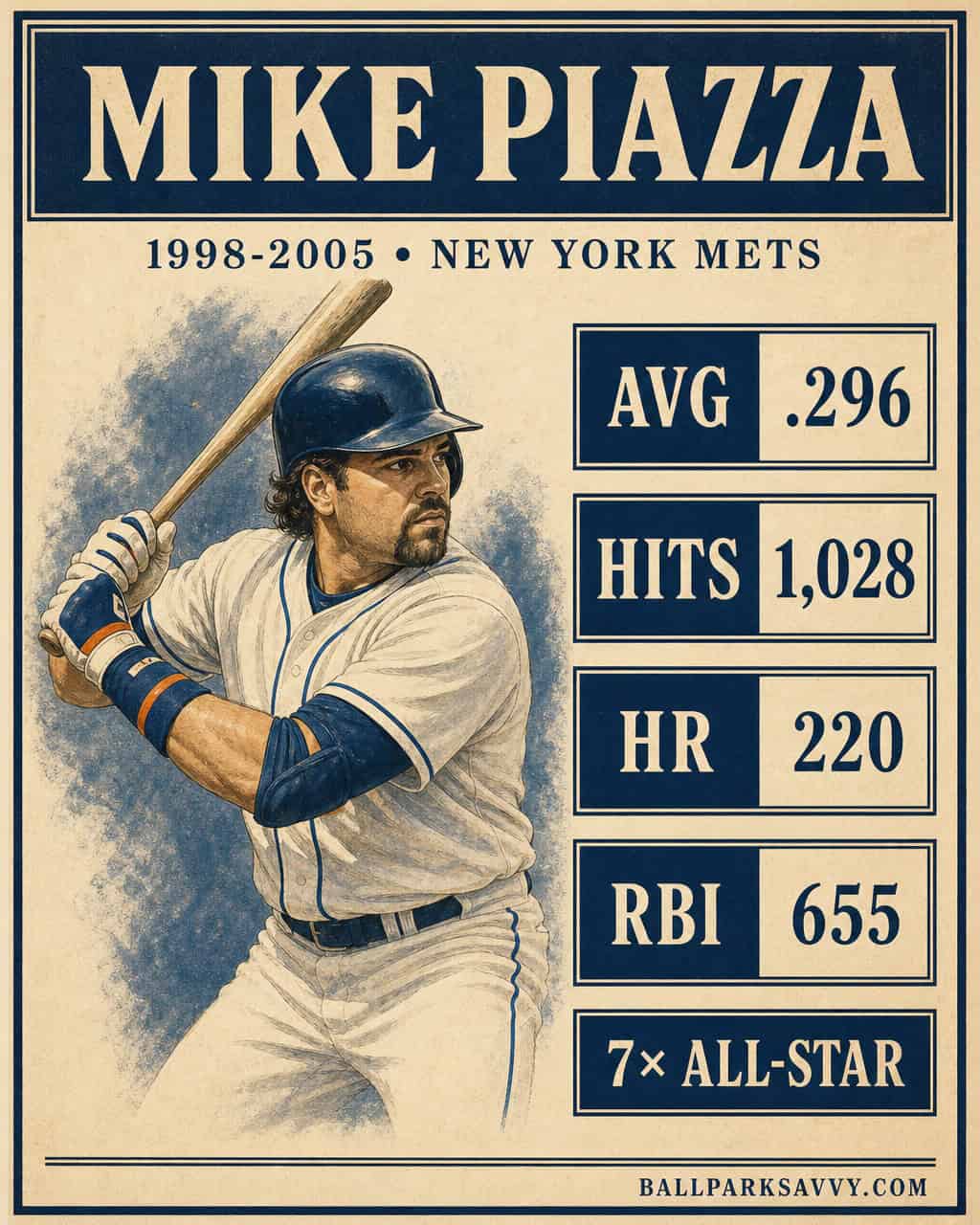
Mike Piazza arrived in Queens in May 1998 and remained the Mets’ catcher through 2005, anchoring the lineup for eight seasons. Over 972 games in a Mets uniform, he hit 220 home runs and drove in 655 runs while maintaining a .296 batting average. He earned seven All-Star selections with the franchise and collected five Silver Slugger awards between 1998 and 2002.
His 1999 campaign stands as the offensive peak of his Mets tenure, when he launched 40 home runs and drove in 124 runs. The following season he hit .324 with 38 home runs, then delivered a crucial home run in Game 2 of the NLCS against St. Louis as the Mets advanced to the World Series.
Piazza’s consistency at the plate defined the Mets’ offense during the late 1990s and early 2000s. His 220 home runs in a Mets uniform remain the most by any catcher in franchise history, and he entered the Hall of Fame in 2016 wearing a Mets cap.
1. David Wright
2004-2018
| David Wright — Career | Total |
|---|---|
| G | 1585 |
| AB | 5998 |
| H | 1777 |
| HR | 242 |
| RBI | 970 |
| SB | 196 |
| AVG | .296 |
| OBP | .376 |
| SLG | .491 |
| OPS | .867 |
| All-Star selections | 7 |
| Gold Gloves | 2 |
| Silver Sluggers | 2 |
With the team: .296 AVG, 1,777 hits, 242 HR, 970 RBI, 7× All-Star
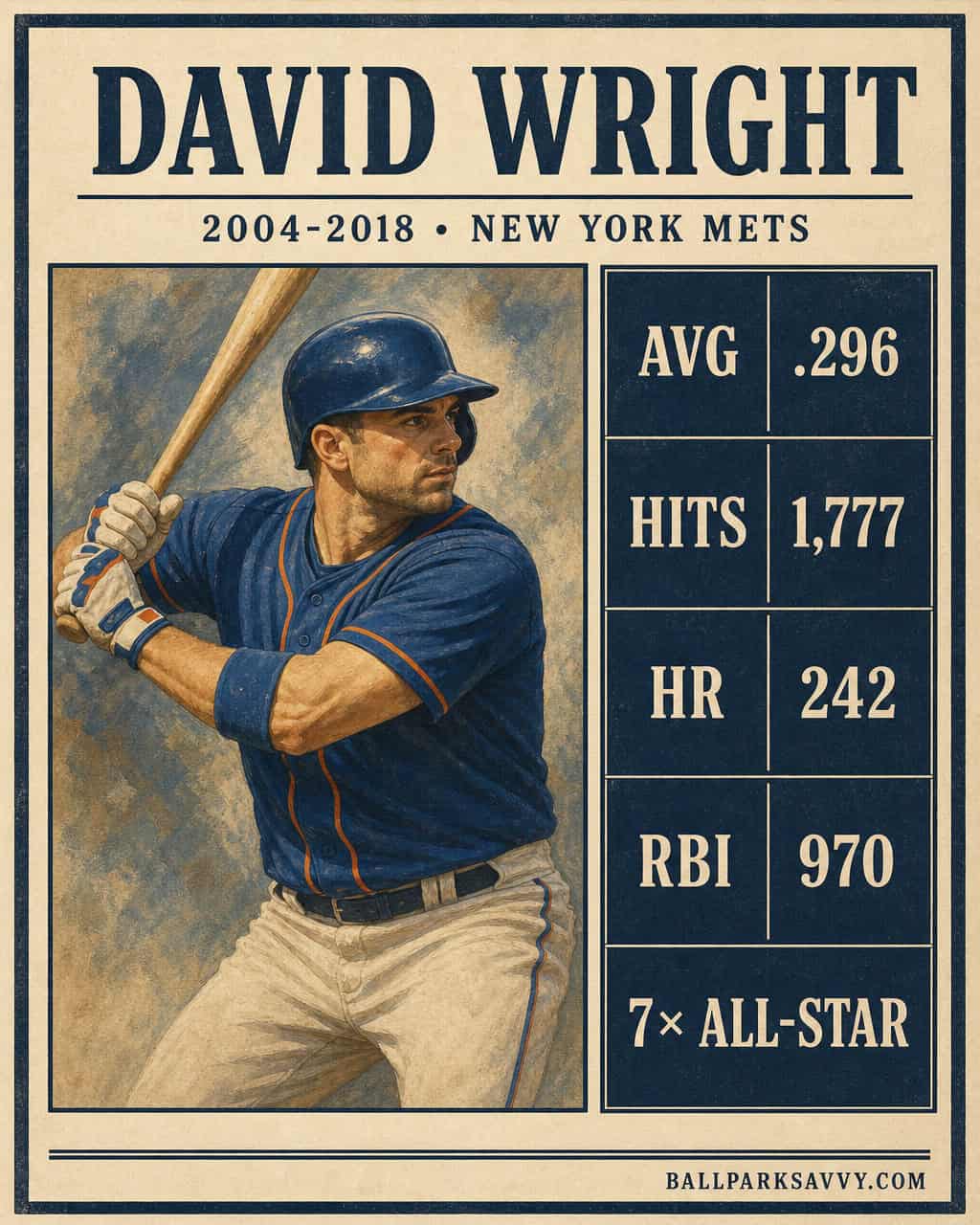
David Wright anchored third base for the New York Mets from 2004 through 2018, appearing in 1,585 games across 14 seasons. He compiled 1,777 hits and 242 home runs while maintaining a .296 batting average in a Mets uniform.
Wright earned seven All-Star selections with the franchise and claimed both Gold Glove and Silver Slugger honors in 2007 and 2008. His 390 doubles rank among the highest totals in team history, while his 970 RBI established him as a consistent run producer throughout his tenure.
The 2007 season showcased Wright at his peak, when he hit .325 with 30 home runs, 107 RBI, and 196 hits. He followed that performance with a 2008 campaign that produced 33 home runs and 124 RBI while batting .302.
In 2012, Wright became the Mets’ all-time hits leader with his 1,419th career hit, surpassing Ed Kranepool. Wright’s 1,585 games rank second among Mets position players behind Ed Kranepool’s 1,853, while Wright’s 1,777 hits remain the franchise record.
The Conclusion
From Darryl Strawberry’s explosive power in the 1980s to Mike Piazza’s clutch hitting behind the plate to David Wright’s 15-year commitment to the franchise, these three legends define Mets excellence. Each brought something unique to Flushing—championship swagger, Hall of Fame credentials, and homegrown loyalty that fans still celebrate today.
Think you know your Mets history? Head back up and test yourself with our trivia quiz. See if you can match these all-time greats with their most memorable moments in the orange and blue.