

Last Updated: June 17th, 2026 by Michael Schatz
Before sabermetrics turned baseball into a spreadsheet, there was Ted Williams—a man who made hitting look like poetry in motion. The Splendid Splinter didn’t just play baseball; he dissected it with the precision of a scientist and the heart of a warrior. These ten statistics tell the story of the greatest hitter who ever lived, each number a testament to an era when legends were forged in the crucible of competition.
Don't lose this article. Enter your email below, and I'll send it to you right now. Plus, we'll send you other unbelievable stories from baseball's past.
The Last .400 Hitter: .406 in 1941

On the final day of the 1941 season, Ted Williams entered a doubleheader against Philadelphia hitting .3995—technically .400 when rounded up. His manager, Joe Cronin, offered him the chance to sit out and preserve the milestone, but Williams refused, declaring he didn’t want to “back into” the record. He went 6-for-8 that day, finishing at .406 and cementing his place in baseball immortality. No player has hit .400 since, making Williams the last member of baseball’s most exclusive club—a feat that grows more impressive with each passing decade.
The Unbreakable On-Base King: .482 Career OBP

Williams’ .482 career on-base percentage is the highest in MLB history and represents the pinnacle of plate discipline. This means that nearly half the time Williams stepped into the batter’s box, he found a way to reach base safely. To put this in perspective, the career on-base percentage of Mike Trout, one of the best players of the modern era, is still dozens of points lower than Williams’ mark. The Splendid Splinter understood that getting on base was the foundation of offensive success, turning every at-bat into a chess match between pitcher and hitter.
Double Triple Crown Winner: 1942 and 1947

Williams achieved baseball’s Triple Crown twice—leading the American League in batting average, home runs, and RBIs in both 1942 and 1947. The 1942 campaign saw him hit .356 with 36 home runs and 137 RBIs, while 1947 brought .343, 32 homers, and 114 RBIs. Only 17 players in baseball history have won a Triple Crown, and Williams is one of just two to accomplish the feat twice. The rarity of this achievement has only increased in modern baseball, with no player winning a Triple Crown between 1967 and Miguel Cabrera’s 2012 season.
The Walk Master: 2,021 Career Walks

Williams drew 2,021 walks during his career, a testament to his legendary eye and patience at the plate. Pitchers feared him so much that they often preferred to put him on base rather than risk giving him something to hit. His 1947 season included an astounding 162 walks, and he led the American League in walks eight times. Williams famously said he never swung at a bad pitch, and his walk totals prove he meant it—turning the batter’s box into a laboratory where he dissected every offering with scientific precision.
Age 39 Batting Champion: .388 Average

In 1957, at age 39, Williams hit .388 to win his fifth batting title—the highest average by a player that age in baseball history. Most players are contemplating retirement at 39, but Williams was still making pitchers look foolish with his swing. He missed .400 by just five hits, proving that Father Time hadn’t dimmed his batting eye or slowed his reflexes. This performance came after missing nearly five full seasons to military service, making his late-career excellence even more remarkable and cementing his reputation as baseball’s most dedicated student of hitting.
Five Lost Prime Years to Military Service

Williams sacrificed nearly five full seasons in his prime to serve his country—three years in World War II (1943-1945) and most of two seasons during the Korean War (1952-1953). He served as a Marine Corps aviator, flying combat missions and crash-landing a damaged F9F Panther in Korea. Baseball historians estimate Williams lost approximately 650 games to military service, potentially costing him 150-200 additional home runs and a chance at 3,000 hits. His willingness to serve twice, despite being established as baseball’s biggest star, speaks to the character of a generation that understood duty came before personal glory.
Six Batting Titles, Eight Times in the Top Two

Williams won six American League batting titles (1941, 1942, 1947, 1948, 1957, 1958) and finished second twice, meaning he was the league’s best or second-best hitter in eight of his 19 seasons. His consistency at the plate was unmatched—he hit below .300 only once in his career. The span of his dominance is remarkable: 17 years separated his first and last batting titles, proving that his hitting prowess wasn’t a flash in the pan but a sustained excellence that defined an era.
Home Run in Final At-Bat at Age 42

On September 28, 1960, in his final major league at-bat, Williams launched a home run into the right-field bullpen at Fenway Park—his 521st career homer. The 42-year-old Williams had hit .316 with 29 home runs that season, proving he could still perform at an elite level. After circling the bases, he famously refused to tip his cap to the crowd, maintaining his complicated relationship with Boston fans until the very end. The storybook ending was pure Williams—defiant, dramatic, and absolutely perfect, cementing his legacy as a player who went out on his own terms.
19-Time All-Star Selection

Williams was selected for 19 All-Star Games during his career. He holds the All-Star Game record for career walks (11) and is tied for the second-most home runs (4). His most famous All-Star moment came in 1946 when he hit a mammoth three-run homer off Rip Sewell’s “eephus” pitch, one of the most memorable swings in All-Star history. The consistent All-Star selections reflect his sustained excellence and the respect he commanded from peers, managers, and fans throughout his career.
The .344 Career Average: The Modern Gold Standard
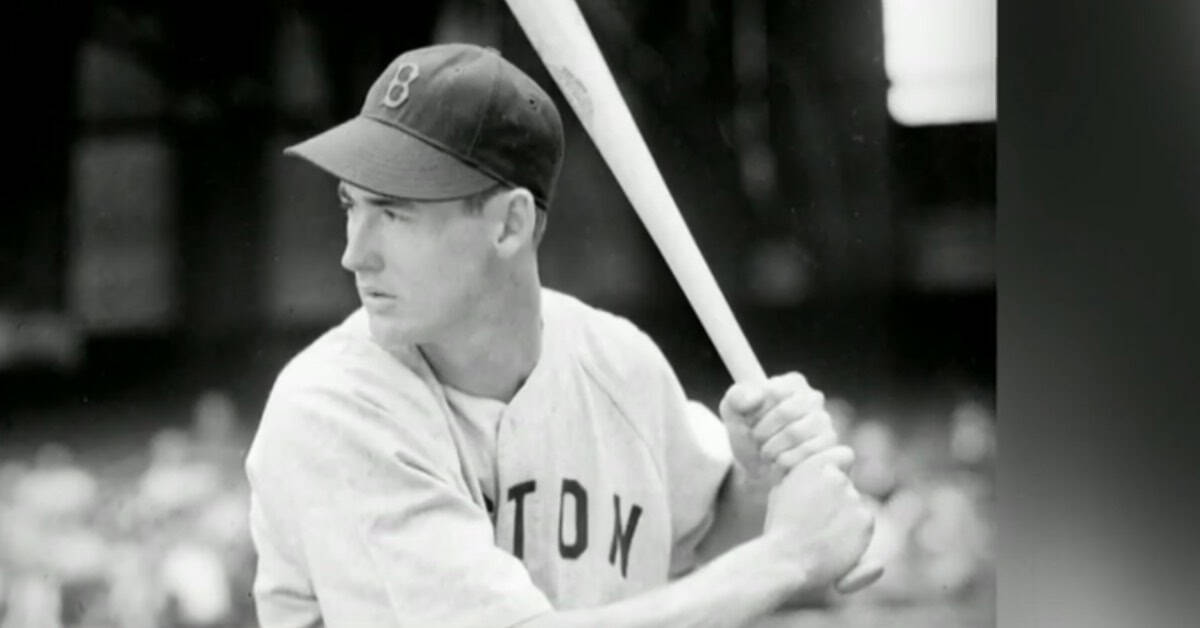
Williams’ .344 career batting average is the highest of any player in baseball’s modern era (post-1920) and stands as one of the best marks of all time. Over 19 seasons and 7,706 at-bats, Williams consistently delivered at a level that modern players can only imagine. His career average is dozens of points higher than any active leader, showing just how far ahead of his time he was. The .344 mark represents pure hitting excellence—not just power or patience, but the ability to make consistent contact and find gaps with a precision that turned hitting into an art form.