Last Updated: October 2nd, 2026 by Matthew Brown
The MLB Draft is probably the least well-known draft of any major American sport. The reason is that every pick starts out as a minor league player (with a few exceptions throughout history).
Don't lose this article. Enter your email below, and I'll send it to you right now. Plus, we'll send you other unbelievable stories from baseball's past.
That being said, there can still be some all-time draft mistakes that hurt a franchise and help another. Let's take a look at some of the biggest.
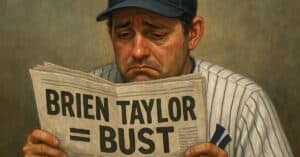
10. Brien Taylor: The Yankees’ Million-Dollar Heartbreak

During the lean years of the 1980s, the New York Yankees just didn't have the elite pitching that championship teams were developing. That's why they entered the next decade with a focus on bolstering their future rotations.
Brien Taylor was supposed to be a part of that plan, but it never materialized. Taylor had a $1.55 million signing bonus that was a relatively new thing in baseball at the time. That ended up as money that the Yankees basically gave away because Taylor is one of the very few top overall picks to never make it to MLB.
9. Steve Chilcott: The Pick Before Reggie Jackson

A catcher can be a cornerstone player for a franchise, and that's what the New York Mets thought they had in Steve Chilcott. It was a curious decision because Jerry Grote was becoming a mainstay as a catcher at the MLB level, so there wasn't exactly a need at the position.
Needless to say, the first overall pick in 1966 ended up being wasted, as Chilcott had a shoulder injury that derailed his career and prevented him from ever reaching Queens.
8. Mark Appel: Stanford Star’s Long Journey

This is as recent of a draft bust as it can get. I remember hearing the name of Mark Appel as he gained stardom in college at Stanford. He won the National Pitcher of the Year Award as a junior and got drafted eighth overall by the Pirates.
He chose not to sign, betting on himself and getting rewarded for it.
He was selected first overall the next year by the Astros. However, Appel saw many struggles in the minor leagues and even took some time away from baseball before finally making his debut almost 10 years after he was drafted. His MLB career lasted a little over a month.
7. Matt Bush: From Shortstop to Troubled Reliever

As the San Diego Padres were deciding on their first overall pick in 2004, they stayed local with Matt Bush, who was a great shortstop at Mission Bay High School in San Diego. He also pitched, which is what the Padres chose to have him commit to, and they ended up moving on from him after a while.
He made his MLB debut over a decade after he was the first overall pick and carved out a small bullpen role for eight seasons. The thing is, the guy who was the second overall pick in 2004 was Justin Verlander.
6. Bryan Bullington: The “Safe Pick” That Wasn’t

In 2002, there were some pitchers that many teams were looking at. The Pittsburgh Pirates just thought they had the closest thing to a surefire All-Star in Bryan Bullington.
He was able to make sporadic appearances at the MLB level over a handful of years, but never became even a regular rotation starter. He eventually opted to leave for Japan, becoming an NPB All-Star in 2011.
5. Brady Aiken: The Pick That Never Was

Brady Aiken was looked at as a future star when he was selected with the first overall pick in 2014. However, after the Astros had their doctors look at him, it was discovered that he had concerning elbow inflammation, and they wanted to lower their signing bonus offer, which Aiken rejected.
That pushed Aiken to the next year's draft and sent the Astros into a tailspin because their lowered offer to Aiken made all of their other signing offers to the rest of their draft class invalid, making it much more difficult to keep the players they drafted that year.
4. Danny Goodwin: The Two-Time First Pick

The only player in baseball ever picked first overall in two separate drafts, Danny Goodwin, seemed to be projected to become a franchise-altering player. He declined to sign out of high school to take a scholarship at Southern University.
He excelled there and signed out of college with the California Angels. He skyrocketed through the minors to join the Angels in September shortly after he was drafted. His MLB career was the opposite of what scouts thought it would be, never becoming an everyday starter.
3. Al Chambers: The Mariners’ Missed Opportunity

The first overall draft pick in 1979 was supposed to bring the Seattle Mariners to prominence. Al Chambers was a powerful high school athlete, excelling at football as well as baseball. The Mariners said his game reminded them of Dave Parker, who was in the middle of his Hall of Fame career at the time.
With those lofty comparisons, Chambers chose baseball over a football scholarship offer at Arizona State. One can only imagine what football could have done for Chambers, as he only saw parts of three seasons in the majors, accruing negative WAR for his abbreviated career.
2. David Clyde: The Rushed Prospect

The business of baseball was just different back in 1973. David Clyde was hyped as a young phenom who the Texas Rangers wanted to push as their future star. They had the second-lowest attendance in the league and used their first overall pick as a publicity stunt more than a valuable member of the franchise.
Owner Bob Short had Clyde make two starts at the MLB level before even heading to the minors. It worked. Clyde's arrival brought a sellout crowd, and he delivered a win just 20 days after pitching his final high school game.
His shine wore off, though, as he ran into injury troubles, which derailed his development and ended his once-promising career at 26 years of age.
1. Jeff King: The Pick Before the Legends

Jeff King is actually the most productive MLB player on this list. He had a .256 lifetime batting average with 154 home runs over an 11-year career. Certainly not what is hoped for out of a first overall pick, but you've seen from this article that it could be much worse.
King is here more because of the picks that were made immediately after him. Greg Swindell, Matt Williams, and Kevin Brown were the second, third, and fourth picks of the 1986 draft, and they all made at least one All-Star team.
Then there's Gary Sheffield, who was the sixth overall pick and hit over 500 home runs in his career. Jeff King, needless to say, does not compare to those guys.